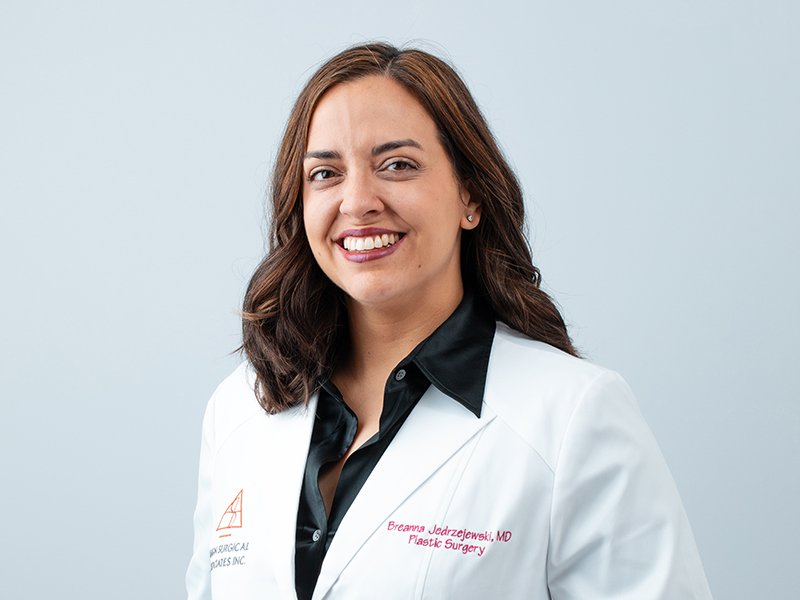
Hi everyone. I hope everyone’s having a great day. My name is Dr. Brianna Jedrzejewski. I’m a board eligible plastic and reconstructive surgeon with Align Surgical in San Francisco, California. Thank you for joining our Instagram live today. I want to let you know we’ve turned off the comments to avoid any potential harmful commentary, but that doesn’t mean you can’t ask questions. Go ahead and submit any questions you have through the question function, and I’ll answer questions relevant to BBL as we go and leave some time at the end in case there are other questions.
What is a BBL? BBL stands for Brazilian butt lift. And it’s a body contouring procedure that we do. It’s feminizing and it involves the transfer of fat from a patient’s body from one area to another. It’s their own tissue and we move it from one area to another. That’s different from silicone implants that might go in the buttocks or the hips because it’s the patient’s own tissue. It’s going to last a lot longer and have fewer complications compared to a foreign body being in your body. A good candidate for BBL has a lot of things in common with just good candidates for surgery in general. So, if you’re looking to get a BBL, it’s best if your health is optimized, and what I mean by that is if you have any chronic medical conditions, it’s best if those are under control like blood pressure or diabetes, it’s good to have well-controlled blood sugars. If you have any autoimmune issues, it’s also good for those to be under control because all of those things can not only affect fat take, but also just in general, we want to reduce your risk for surgery.
Safety is the absolute most important thing. We want you to be optimized for surgery. Someone who has a history of extensive abdominal surgery or existing hernias may not be the best candidate for a BBL. Another thing that might make you less of an ideal candidate is if your BMI is very low and there’s just not fat present enough to transfer because we’re trying to transfer large volumes that um will help you reach your embodiment goals by achieving a proportion of waist to hip ratio. That’s kind of our ideal. That’s what we’re going for. So, if you don’t have a lot of fat to give, then this might not be the procedure for you.
On the other hand, distribution of body tissue is important in terms of setting expectations and deciding whether you’re a good candidate for this procedure. Some people carry their fat on the outside of their abdomen and some people carry it mostly on the inside of their abdomen. Everyone is a blend of both, but um it’s the fat on the outside of the abdomen that we’re able to harvest and basically relocate. So, if a lot of your fullness comes from intraabdominal fat in terms of from the waist area, that will not go away with a BBL because we do not enter the abdomen during BBL liposuction and fat transfer. So, those are important things to know.
It’s just important to be realistic with expectations of how much you’re going to be able to achieve by transferring fat if you’re a very high BMI versus waiting until you’ve reached your ideal weight and then getting a BBL at that point. So in terms of what the surgery involves from start to finish, the patient undergoes general anesthesia. They are marked prior to surgery in the front and back, and in the surgery we usually have the patient start lying on their back and we harvest fat from the abdomen, the flanks, and sometimes other specialized areas. Like the arms and the inner thighs. We harvest that fat um and then we flip the patient over onto their stomach. We harvest more fat from the back and the waist and then we process the fat. We wash it with saline. There are other techniques, and then we reinject the fat in the hips and the buttocks at the end of the case. So that is how the surgery goes. Usually it can take like 3 1/2 hours, sometimes longer, sometimes shorter depending on um how much fat the patient has to transfer. At the end of the case,we put the patient in a compressive garment and they stay overnight with us because when we’re transferring a lot of fat there’s a lot of fluid shifts and we just want to monitor for the first night after surgery. Then you go home and you recover.
There’s usually two drains: one in the front, one in the back. Sometimes there can be two in the front and one in the back. It all depends on the patient and the surgeon. Those drains just help to decrease swelling by allowing fluid to come out that has been put in during the procedure. Those drains usually come out the first week postop which is the first time that we see you in the office afterwards. Tt’s important to expect a lot of bruising, swelling and aching right after surgery, but we work with patients to help manage their pain, which usually decreases significantly after the first couple days. Although you can be sore several weeks out from surgery, it all depends on the patient.
In terms of working with patients to decide the size and the shape they want, I think it’s important to realize that in general our patients want a significant change and we have the materials that they are providing for us, right? We are using the fat that the patient’s providing. If you have enough fat to transfer then that will result in a significant change after surgery. Sometimes more than one surgery is needed in order to achieve the volume that meets our patients embodiment goals. It’s important to know that in every transfer of fat there’s 50-80% of the fat that we transfer that stays, which means that 20-50% of the fat goes away. Sometimes people are really pleased with the results right after surgery and they’re really swollen, then over time the swelling goes down, things settle out and they are either really happy or they feel like they need additional volume and that can be achieved through another surgery.
So, what is the balance between achieving a fuller look and ensuring natural proportions? I think that depends on how many rounds of fat transfer that you’re able to do. I think it’s about balancing how much you transfer at the time. You want to transfer enough but not too much because if you transfer too much fat at the time of surgery, it can be counterproductive in terms of fat survival. So, it’s kind of a delicate balance, which brings me to the point of what should patients be aware of when choosing a qualified surgeon? I think it’s really important for patients to seek out a board eligible or board-certified plastic and reconstructive surgeon. You definitely want someone who has a lot of experience with liposuction and fat transfer. For our patients, they know that we have a lot of experience with these high-volume transfers. On average, I think 2.2 liters of fat is transferred on our patients, oftentimes more, and sometimes less just depending on the patient. So, in terms of recovery and timeline, we’re looking at 6 to 8 weeks. In general, I think for the first one to two weeks, there’s a lot of, discomfort, swelling and bruising and you have the drains for one week. You might be needing a little bit of narcotic, so, it it’s definitely not a time to jump back into work. During that time, I think most people take four to six to eight weeks off. It depends on what you do for work, of course. You want to avoid putting pressure on the sites that have been grafted because those fat cells need to survive on the fat, the blood supply around it before they create their own. Any kind of pressure on those areas will prevent blood and oxygen from getting to those fat cells. So that means that you want to avoid any prolonged sitting, you want to sleep on your stomach. If you cannot sleep on your stomach, then it’s important to have special pillows that basically elevate and offload those areas that have been grafted. Those are really important things to think about in terms of recovery. You can sit or lie down normally again. I would say after six weeks maybe you can stop being so strict but I wouldn’t think that it’s important to be cognizant of the area and to offload as much as possible and to wear your faja from six to eight to 12 weeks after surgery. It really depends on how much the patient is able to tolerate the compression and restrict their activities. Everyone’s really different. There are guidelines to help you to keep as much of the fat as possible um that you’ve had transferred.
How much of the fat typically sticks? As we said, 50 to 80%. A question we get often is, will weight fluctuations or aging affect the results of a BBL? And the answer is yes, of course. So just like any procedure, gravity and aging will definitely affect the results. The thing about BBL is that the fat you have has been transferred to another area of your body which means that if you gain weight or if you lose weight, you will gain and lose weight in that area of your body just like every other area of your body, right? So, if you have a massive weight loss after BBL, you can expect the volume of your buttocks and hips to go down in proportion to the rest of your body. If you gain weight, the same is true. You will gain weight in those fat cells. They function similarly and they will hypertrophy or get bigger if you gain weight. In terms of diabetes, we know that diabetes constricts small blood vessels and those are the same small blood vessels we rely on for the fat to initially live off of and then create its own blood supply. That’s why it’s so important for anyone who has high blood sugars to have them well controlled prior to this surgery because it can affect the percentage of fat transfer. In terms of GLP-1 drugs, that’s also a question that we get. We don’t have a lot of evidence in terms of whether it affects the fat retention like in the short term. But just like losing weight in the long term, you if you are on a GLP-1 and you are losing weight over time, that will affect your results in terms of the volume that you’re able to retain in your buttocks because it’s going to affect your body proportionally.
Another question that patients have is are they able to get additional procedures or touch-ups later on? The answer is yes, but the caveat is that insurance may not always authorize revision procedures for BBL. So that would be something that you’d have to verify with your insurance, and we’re always happy to help patients through that process to find out what is covered with their insurance. I think now could be a good time to look at some of the questions.
The first question is “I’m curious if you’re located in San Francisco or Los Angeles.” I am located in San Francisco, but Align also has two surgeons that are located in Los Angeles. Having said that, we see patients here in San Francisco from all over the state of California and from other states as well.
This is a great question. “When someone starts their gender affirming surgery, is there a recommendation on how to sequence procedures? For example, bottom surgery followed by BBL followed by FFS, for example. And how do you guide someone to make these decisions on gender affirming sequencing?” I think that at the core of everything we do, everything depends on the patient’s goals. I have patients who come to me with consults for all of these surgeries and the thing that I want to ask them is what do you want to have done first? Whatever they find to be most affecting their dysphoria is the procedure I usually think we should do first. If they ask me, “what is the hardest procedure to recover from or what would be a more straightforward recovery?” I would say something like top surgery or breast augmentation might be a great first operation. If they’ve never had surgery before and if they’re experiencing a little bit of trepidation and they want to know how recovery from surgery goes, those are good surgeries to start with. It depends on whatever the patient wants and I think that body contouring even though there are small incisions it can be one of the surgeries that is most uncomfortable just in terms of having to offload. We sit a lot in our lives, right? So I think you have to be cognizant of standing and not sitting for long periods of time and then wearing the compression and sleeping on your stomach. In terms of like modifications, I think it has a lot of consequences in your everyday life when you’re recovering from BBL in that sense. I hope that makes sense in terms of sequencing of surgeries. I think that first and foremost it’s important to understand what is most important to the patient and then if they have questions outside of that on how to sequence them then I can always give my advice in terms of that. It’s important that whenever you’re having surgery, especially multiple surgeries, that you take adequate time to heal between the surgeries. I think an ideal time is at least 2 to 3 months after and that is as long as you’ve had no complications. If you have complications from surgery then you need to allow yourself even more time between surgeries.
Another great question, “is there a BBL BMI limit?” Not officially. There’s not for our practice anyway. If your BMI is above 40, then we will do your case in a hospital setting. Just because there can be higher risks in terms of airway support. I think it’s important to be in a hospital setting if you need any supportive care, but the short answer is no. We do not have a BBL BMI limit because as a lot of people have realized BMI doesn’t always account for how your body mass is distributed, right? So people with very similar BMIs may have very different distributions of body fat and mass. So I think it’s important to be evaluated by your surgeon to see if you’re a good candidate.
Another question is “can I get a BBL with not a lot of fat?” I’m thinking what the question is asking could be asking one of two things: one is if you don’t have a lot of fat, can you get a BBL? And then the other interpretation I am having is that can you just get some fat transferred or if you don’t want a lot of fat transferred. So to answer my first interpretation of it is that can I get a BBL if I don’t have a lot of fat? You can, but you are doing it with the understanding that if you’re not transferring a lot of fat then you might not be able to get as significant of a result right so if you’re just trying to fill some hip dips then maybe if you’re on the lower side BMI that would still be enough fat to fill those but it certainly wouldn’t be enough to put in your hips and your buttocks and get a considerable enhancement in terms of shape. If you say you had a lot of fat to give but you only want some of it to go to your hips and your buttocks, then yes, of course, you can talk to your surgeon about maybe not wanting a very high volume of fat if that’s not within your embodiment goals. I think that you can customize the transfer of fat just depending on your embodiment goals and what’s possible in terms of how much fat your body’s able to loan to other parts of your body.
Those are all the questions that I have currently…I see another one here. It says, “Do you transfer do you recommend lipo of the genital area as well before um SRS?” Sexual reassignment surgery and losing weight and concerned about the effect weight will have on the area and aesthetics. In that case, I think that it makes sense to do the bottom surgery first before you do the body contouring because you can make the torso match the fullness of the bottom surgery or vice versa. That’s the order that I would recommend because you want your body in general to be at a stable weight and in a stable place before your body contour. Then if it changes significantly after that, you might not be as happy with the results. I hope that answers that question. I have another question, “Can you also transfer some fat to my lips and cheeks at the same time that you’re transferring fat to my hips and buttocks?” And the answer is yes. We can do that. If you wanted fuller lips or cheeks or some facial fat grafting or submental liposuction, that would be appropriate to do at the same time as BBL.
Someone asked, “can there be too much belly fat for BBL?” It depends. If you have all that belly fat internally, it’s just important to know that body contouring is not going to narrow your waist as much as if the fat was located on the outside of your abdomen. Because at the same time that we are enhancing the hips and the buttocks, we are also narrowing the waist which just compounds the effect and gives the more feminizing contour, right? Because we’re aiming for a ratio of waist to hips that’s 7. So, the narrowing of the waist is important in terms of being able to give a balanced look and really emphasize the augmentation of the hips and the buttocks.
“Do certain doctors specialize in more dramatic curvy results?” That’s a great question. I think that a good starting place is to look at the before and afters of a surgeon’s gallery on their website to see if there are patients that have a similar body type to you and then if they are able to achieve a body shape that fits your embodiment goals. That’s a good place to start. Certainly surgeons get well known for the work they do. You might have a friend who got a BBL and was really happy with it and had a really dramatic result and that would certainly be somewhere to start in terms of finding a surgeon that can give you the results that you want. I think in general, in our practice we give dramatic results because of the high volumes that we’re transferring. I know in some aesthetic practices, they consider high volume maybe like 500 milliliters of fat. In our practice we consider high volumes over 2 L of fat. We are definitely transferring the most fat that we can.
“Do you use the latest power assisted equipment for optimal results?” Yes. We do use power assisted liposuction which has been associated with increased fat retention and just optimized results in general.
“As a medical professional, are you concerned about insurers increasing denials or introducing additional barriers for gender care under the current administration? Thank you for everything you do.” Yes, I think that it’s always an ongoing battle with insurance companies. We’re seeing in general more of a need to have peer-to-peer reviews with insurance where they might deny a procedure for a patient and then we have to talk to them about the medical need for the procedure. Sometimes those surgeries still get denied. Sometimes we’re able to reverse the denials, but I think increasingly, not just in this space, but in every kind of medicine where insurance is accepted, insurance-based medicine. I think this is a problem where coverage is shrinking and the need is unfortunately growing in terms of people needing to get the life- saving lifegiving care that they deserve. That is a significant obstacle moving forward but we are really dedicated to advocating for our patients and whether that’s dealing with insurance companies and trying to get our surgeries covered versus working with our community network. We’re committed to our patients and trying to get the best care for them. Thanks for asking that question.
Our time unfortunately is up. It goes by so fast. Thank you so much everyone for your thoughtful questions and I look forward to seeing you again and talking about another topic. Take care.