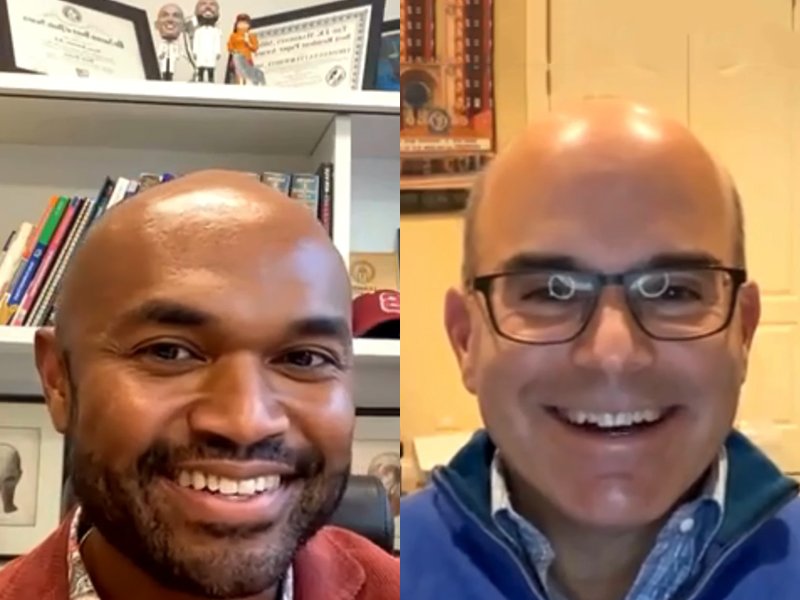
Dr. Loren Schechter, a board-certified plastic surgeon and national and international expert in gender-affirmation surgery, joined Align’s Dr. Thomas Satterwhite on Instagram Live to discuss common myths about gender-affirming surgery. Watch this informative discussion by clicking “play” on the video below.https://www.youtube.com/watch?v=Vz7m-Yg4e1cCaption/subtitle instructions: To turn on subtitles, turn on closed captioning (CC icon), located at the bottom right of the video. To change the language, go to settings > subtitles/cc > auto-translate. Then, select your native language.
Dr. Satterwhite:
Hi Thomas, how are you doing?
Dr. Schechter:
Quite well. Super excited to have you here, and thank you for making the time in your busy schedule.
Dr. Satterwhite:
And thank you everyone for joining us tonight in our Instagram Live — or good morning, depending on where people are watching from. Tonight’s discussion is going to be on debunking myths in gender affirming surgery. There are a lot of myths out there, unfortunately, that have developed over the past couple of years. I want to have this conversation with Dr. Schechter to explore those and find ways that we can change that — for the sake of our patients.
Just a brief introduction: I’m Dr. Satterwhite, a plastic surgeon based in San Francisco who performs gender affirming surgery.
Dr. Loren Schechter — it would take me half an hour to go through his entire resume — is a professor of surgery, runs a gender program at Rush University, and is heavily involved in research. If there’s any landmark paper in gender affirming surgery, his name is on it. Outside of his academic and clinical pursuits, he is heavily involved in every organization out there — on the board of directors of WPATH, now president-elect (woohoo, in two years you’ll be the formal president of WPATH).
He’s been involved in developing the standards of care for WPATH and the care of our patients. On top of that, he’s a member of numerous organizations — American Society of Reconstructive Microsurgery, ASPS, the American Society of Plastic Surgeons, the Gender Society, and many more.
He’s also an advocate, involved in expert testimonies in several high-profile cases across the country. Everyone throughout this world and universe knows who Dr. Schechter is.
Just one quick housekeeping note — we do have the comments turned off to avoid potentially harmful commentary. But if you have any questions throughout the discussion, ask them using the question function and I’ll look through and point them out.
Dr. Satterwhite:
Dr. Schechter — you do so much, you’re tireless. What drives you?
Dr. Schechter:
First of all, Thomas, call me Loren, please. It’s a pleasure to be here and I appreciate the opportunity.
Thank you for your role and your service as program chair, scientific chair for the most recent WPATH meeting in Lisbon. It was a wonderful meeting. Dr. Satterwhite, Dr. Musozer were two of the program chairs, and it was the largest meeting we’ve had to date. So thank you very much.
What drives me? It’s a great question. Let me thank our team at Rush — without all their help, I wouldn’t be able to do the work and care for our patients.
I’ve been performing surgery and involved in the field for a number of years. It’s near and dear to my heart. I feel very passionate about the work — both as a physician and as someone helping people and trying to advance the field.
Early on, there were many challenges. Access to care was limited, insurance companies didn’t cover it, hospitals were reluctant to allow surgeries. We’ve really come a long way. We’ll talk about those challenges tonight, but we’ve come quite a way.
So, those are the things that really drive me and keep me going.
Dr. Satterwhite:
Just speaking about what’s happening recently — gender affirming surgery has been around for decades, and it’s just recently that it’s become more visible in the public eye.
What I want to understand — and maybe get some insight into — is why is gender affirming care for minors being brought so much into the public conversation, and in such a negative light? Why is that?
Dr. Schechter:
You raise a good point. I think it’s important for people to recognize — we hear many criticisms and critiques of the field in the modern era, but gender affirming surgery has existed under different names and terms for almost a hundred years. It’s not new.
The benefits of surgery have been reported by surgeons and healthcare professionals for decades, across the globe.
Some of the challenges we face, especially with young people, are due to an increase in the number of young people who seek medical and surgical interventions.
The ratio — the number of people assigned female at birth — has increased. Historically, the majority of people we saw were assigned male at birth.
About 10 to 12 years ago — maybe a little more — we began to see more people assigned female at birth. Many of those procedures are gender affirming chest surgeries — chest masculinization.
We’ve recognized the heterogeneity and diversity of gender. We see more people identifying as nonbinary or gender diverse.
That’s part of why people are raising issues around affirming care for minors.
For people who are unfamiliar with the field, education is extremely important.
When you sit and talk with people, meet with them and their families, and hear their stories — I think you really begin to understand what it is we do and how we’re helping people.
Dr. Satterwhite:
That totally makes sense. So, what can we do to depoliticize gender affirming care — particularly for minors? Is there any hope?
Dr. Schechter:
I think there is hope. As we started this talk, we’ve come a long way in the last couple of decades.
When I started, insurance companies didn’t cover care. Now, the overwhelming majority of our patients are covered by insurance.
When I started, many people had to leave the country to access medically necessary care — now that’s no longer the case.
You see diversity programs, Human Rights Campaign expanded insurance coverage, and a growing number of hospitals and academic programs have started not only surgical programs but also comprehensive programs in gender health and LGBTQ+ care.
So I think it’s about evidence, and it’s about education.
Part of our role and responsibility is to add to the evidence and scientific data.
What do we need? We need more studies — larger studies, larger patient samples, longitudinal data.
We need to continue building on the strong foundation we already have.
Dr. Satterwhite:
That’s a very good point. Just touching upon research — we all acknowledge that we need more of it — but do you feel that gender affirming care is held to a different standard when it comes to so-called “high-quality” research compared to other surgical fields?
I know you wrote a recent paper showing that the level of evidence for gender affirming care is on par, if not better, than that for plastic surgery or urology. So why the different standard?
Dr. Schechter:
That’s an important point. The term “level of evidence” has been weaponized in the area of gender affirming care, and it’s applied disproportionately in our field.
For the viewers — “levels of evidence” refers to study design. They’re graded from level 1 to level 5. Most of the evidence we have is level 3, 4, and 5.
That doesn’t mean poor — it means it’s level 3, 4, or 5 evidence. That’s the reality for surgery and clinical medicine in many areas.
We have limitations when it comes to level 1 studies — randomized controlled trials.
In surgery, many criteria for higher levels of evidence — like blinding participants — don’t apply. If we’ve operated on a body part, people know. There’s no placebo in surgery.
We believe it’s unethical to randomize people away from medically necessary care or coerce people into research studies just to access that care.
So, the levels of evidence in gender affirming surgery are similar to many other areas of surgery, but the argument is used unfairly to question what we do.
Dr. Satterwhite:
Thank you. I mean, are there studies that show that gender affirming care is harmful?
Dr. Schechter:
Well, so what we know — we know gender affirming surgery in appropriately identified people is safe, it’s effective, we consider it medically necessary.
The benefits include improvements in overall health and well-being, reduced negative health outcomes, reduction, alleviation of gender dysphoria.
We’re often asked to produce these mountains and mountains of evidence — and I’m not here to speak against the importance of the medical literature — that’s important, and that’s one component of our decision-making process.
But so is our clinical experience. So is the experience of our patients. So are our patients’ values and preferences.
And just like any area of medicine, that’s how we use the best available evidence. We speak with our patients, we engage in the shared decision-making process to arrive at a treatment plan that is most appropriate for that individual person.
Dr. Satterwhite:
Yeah, and that completely makes sense. And what’s also interesting is that for young people, gender affirming care is even provided to cisgender kids and adolescents.
And I think folks don’t understand that — so the use of hormones, gynecomastia surgery, or operating on young girls who might have gigantomastia, right — that’s also been done all the time on our young patients, but it’s not addressed.
And that’s held to a completely different standard than the types of operations that are performed on transgender and gender diverse kids, right?
Dr. Schechter:
Well, we know, Thomas — you and I know — that plastic surgeons perform breast reduction in cisgender young women under the age of 18.
Rhinoplasty under the age of 18. Gynecomastia surgery. And these are all helpful procedures — again, in appropriately identified people.
And so to suggest that similar, analogous procedures are not helpful in appropriately identified young adolescents with gender dysphoria — I don’t think is fair, I don’t think it’s equitable, and I don’t think it’s accurate.
Now, we also know, to be fair, that not all individuals undergo surgery.
So I think one of the misconceptions is that we’re talking people into surgery, we’re trying to coerce people into surgery, that an individual who experiences gender incongruence or gender dysphoria somehow is automatically set down a path of medical or surgical interventions — and as we both well know, that’s not — that’s simply not the case.
We work with colleagues in other disciplines in a multidisciplinary way — whether it’s colleagues in primary care or endocrinology or behavioral health or mental health.
And so you referenced breast reduction in cisgender adolescent girls, gynecomastia in young cisgender boys — none of these people undergo the same rigorous processes as individuals contemplating, for example, masculinizing chest surgery.
Dr. Satterwhite:
Yeah, that’s a very good point. Right, and the way that I view it is, for all of our patients, it’s like someone who’s going through an organ transplantation, right?
That’s the degree of interdisciplinary evaluation that our patients have — so people from multiple areas of medicine who are taking care of and evaluating our patient.
We’re not out there just pulling people into the office, doing these operations and just shooting from the hip.
And I think it goes to your point, Loren — it’s about education. I think everyone needs to understand just the high level of rigor that is involved in taking care of patients.
I think the one thing that’s also brought up — switching gears slightly — the other concern that’s brought up is that, “Well, young people, you know, their brains aren’t developed, and they’re going to have regret.”
Right? And so we shouldn’t be operating now. So what do you say? I know because I have people ask that all the time. What do you say to that?
Dr. Schechter:
Yeah, and you know, that’s a good point. I think we as professionals, healthcare professionals, and surgeons have to understand — when people have those questions — regret.
And we can talk a little bit about regret — it’s a bit of a nebulous concept, but we’ll talk about it.
I think we have to acknowledge that too.
So one of the things that we engage in as part of the consent process and part of the consultation is that sort of future thinking, or forward thinking.
What if? What if your needs change? Have you thought about that? And have you given consideration to the possibility that things may change in the future?
We talk about regret — and that’s an interesting term, because it’s really not well defined. And again, it’s used — it’s weaponized in this field.
If we look at regret regarding medical decision-making in the area of gender affirming care, it’s lower than in many other areas.
And I attribute that largely to the extensive process that we take in people considering surgery — that multidisciplinary process, that discussion with primary care, behavioral health, mental health, surgery — really the preparation.
Not to mention the fact that people have typically thought about the procedures for a long time. Waiting lists are long.
So it’s not as if they see you, Thomas, today, and they’re in the operating room in a week.
So it’s a process. And it’s a lengthy process for many people.
And again, we attribute our low rates of regret — meaning “I would have done something different” — to this process.
Now, we also know though that we have to manage expectations.
We know that the world doesn’t change when someone has surgery. The world can be a difficult place.
People face ongoing discrimination, ongoing stigmatization. And preparing people for that — that resilience — to understand that the world can still be a difficult place, especially for gender diverse people — that’s part of what we’re here to help people with.
Dr. Satterwhite:
Yeah. And so then do you think that, you know, young folks have the ability to make appropriate decisions for themselves?
That’s a question brought up to me.
Dr. Schechter:
I think, you know, that’s on a case-by-case basis.
There are things that we look at, there are things that we look at in conjunction with their other healthcare professionals, their team of professionals — their primary care professionals, their behavioral health, mental health professionals — and so that’s a case-by-case basis.
There will be some young people who do have the ability to make — to engage in future thinking, to understand the process.
There will be others who need more time. That’s not necessarily — or age isn’t the only factor, you know, with that.
And so, of course, you know, we operate as plastic surgeons on people under the age of 18 for a range of conditions.
Now, we also obviously engage the parents and caregivers.
So for people under the age of 18, there’s the parallel process of assent — their ability to understand the risks, the benefits, the options — but it’s also the parents who engage in that informed consent process and provide consent from the legal perspective before proceeding with surgery.
Dr. Satterwhite:
That’s true. And there was — at the WPATH conference — there was a wonderful presentation, I forgot who gave it, but talking about the idea where we allow, you know, people and young people to pursue risky things and don’t really bat an eye about it.
So, such as sports, for example, right? Or driving, right?
But we don’t allow them to self-explore, you know, and take risks when it comes to their gender, perhaps.
And it just makes me wonder — what is it? What is it about gender that people have hang-ups about?
What is it that’s making people have this kind of double standard in terms of how they view it?
Dr. Schechter:
Well, yeah, I think we look at it in different levels.
So, you know, before we engage in surgery — an irreversible process — we want to ensure that people have gone through a very thorough process of self-reflection.
That they’ve had the maturity, they have the insight, they have the ability to assent, their parents are in agreement.
And so, I think it’s that process — or what I like to say, the integrity of that process — that I think is really critical for people contemplating, young people contemplating, surgery.
I think as far as exploring socially, sexually — those are certainly things that adolescents and young people and adults will do.
Dr. Satterwhite:
Yeah. And so, can you add — I think the regret and detransitioning oftentimes get intertwined, but they’re separate things, right?
Could you tell me the differences — and for the audience — between regret and detransitioning?
Dr. Schechter:
Yeah. So, you know, again, it’s interesting.
We don’t use this term “regret” in other areas of plastic surgery.
So, I would ask you, Thomas — how many times in your career have you removed breast implants in a cisgender woman?
Did you ever call it regret? Did you ever term it that?
Dr. Satterwhite:
No. No, no. It was just time for a change.
Dr. Schechter:
Time for a change, right.
Regardless of why they were placed — for reconstructive purposes, for aesthetic purposes — you know, many times someone’s 70 years old and they say, “I’m done.”
“Just take them out.” And we never call that regret.
And so, it is this sort of double standard or disproportion — you know — difference in the use of terminology.
And one of the things I would like to do is start applying that term “regret” to all of these procedures in plastic surgery.
So if we look at regret — right — the regret of “I’m wrong. I’m not who I believe myself to be.” That’s low, right?
Can people have regret around a procedure? Of course. And that occurs in every surgical procedure, every medical intervention.
But remember, regret is bidirectional.
And I would say early in my career, more people regretted not having access to care — because of all the barriers, whether lack of insurance coverage, etc., or limited number of surgeons.
And so, people lacked access and regretted not having access to this important and medically necessary care.
Now, the term “detransition,” for example — someone may, for instance, stop taking hormones.
They may do that for any number of reasons.
Sometimes there’s a medical reason for it.
Sometimes they feel they’re no longer needed.
And those are individual reasons.
If we talk or look at requests for surgical reversal — while they’re not common — I think it’s incumbent on us to speak with patients, understand what the basis of that request is.
We have to care compassionately for people.
We have to listen to them, and if possible, help them.
Dr. Satterwhite:
Yeah. So the theme that I’m getting here — everyone — you know, I wish everyone could understand — is that we listen to our patients.
We take them on a case-by-case basis, and we work with them.
There’s no coercion, there’s no — I mean, we’re human beings and we’re providing, I think all of us — patients, doctors — and we’re just working together to provide the best care for the people that we’re working with.
Dr. Satterwhite:
I just had — speaking of — someone question when we were talking about permanent. So someone was asking about facial implants.
Some of them, just briefly, can be permanent, meaning that we do leave them in. They can be taken out.
Once again, if you do have issues with those implants or, once again, you just have a change in how you feel about your face — just like with breast implants or other aspects of surgery.
One other person who’s listening was asking about intersex — and are there, you know, specific precautions we need to be mindful of? Or what is our approach with intersex patients? Could you comment on that, Loren?
Dr. Schechter:
So, you know, the care for people — intersex or variations in sex traits — is also evolving and has changed.
Generally now, I would say the trends for children, for adolescents, are ensuring the ability to urinate, to defecate, to preserve reproductive capacity if possible — but generally to defer interventions such as vaginoplasty or certainly phalloplasty until the patients are older.
Until the people are older and they can engage in that informed consent discussion, assent to care, articulate their preferences.
So early on it’s focused on bodily functions, preservation of reproduction. And then as people get older, there may be interventions to align their body — anatomically — with their identity.
Dr. Satterwhite:
Yeah. That totally makes sense.
So I think we’re down to two minutes, so I think one question I wanted to ask you is: What do you think — what is it that we can do — as surgeons and other medical providers — can do amidst all the pushback that’s going on to really help support our patients?
I mean, there have been some times — and maybe you as well — where you’ve come across folks who might be in training and they’re like, “Oh my gosh, I’m nervous about going into the profession of gender affirming care because of some of the pushback — and maybe even some of the violence or potential violence.”
What can we do to keep fighting for our people?
Dr. Schechter:
Yeah, you know, I think that’s a great point, Thomas. I know we’re short on time.
But, you know, one thing I would say is, we want to engage in ongoing research, ongoing academic study.
And the current environment makes that difficult.
Why is that difficult, people may ask? Well, do you have a registry?
I can tell you — in speaking to patients — people are afraid.
They don’t want their names put on lists.
When you have government entities requesting private health information from universities and from hospitals — people are very understandably scared and reluctant to participate in registries and longitudinal data.
So it really creates this chilling effect on our ability to get more data. People are simply scared.
I think for the trainees — people who are interested in it — I think it’s a wonderful time, in the sense that there are infinitely more opportunities to learn than there were a couple of decades ago.
And so you can avail yourself of any number of surgeons who would be willing and more than interested to allow you to observe.
Educational opportunities have expanded dramatically — whether through WPATH or other educational offerings.
And so I really think there’s a lot of robust and high-quality educational opportunities out there.
Dr. Satterwhite:
Yeah, and that totally makes sense. It really is about education.
So we are at the half hour mark. This went by so quickly — I could have you forever — but I wanted to thank you, Dr. Schechter, for spending this evening with us and just providing this wealth of knowledge to me and to everyone who’s listening.
We did record this — we’ll have it posted by next Monday, so other folks who weren’t able to attend can view it.
If you want more information, you can go to our website, alignsurgical.com, or Instagram @AlignSurgical, or go to WPATH.org for additional information as well.
Once again, thank you so much, Dr. Schechter — or Loren.
Dr. Schechter:
Thomas, thank you so much. I really enjoyed it. It was a pleasure.
Dr. Satterwhite:
Yes. Till next time. Take care.