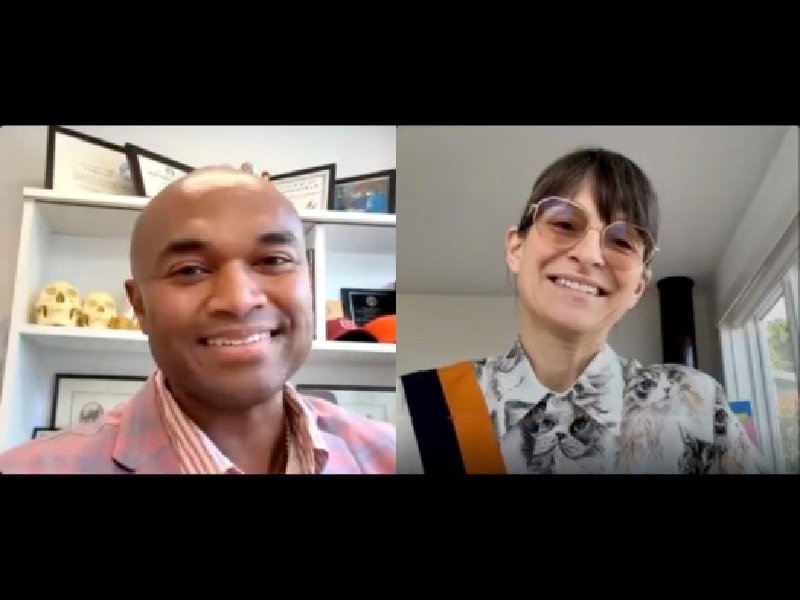
Dr. Satterwhite, a board-certified plastic surgeon, hosted an Instagram Live discussion with author of Tits Up, Sarah Thornton, on the cultural, medial, and personal meanings of breasts.
https://youtu.be/ylp4pG7kLfACaption/subtitle instructions: To turn on subtitles, turn on closed captioning (CC icon), located at the bottom right of the video. To change the language, go to settings > subtitles/cc > auto-translate. Then, select your native language.
Thank you for watching!
Dr. Satterwhite: This is super, super exciting. We’re doing an Instagram Live! I’m super excited to be here and it’s an absolute pleasure and an honor to be with Dr. Sarah Thornton. And she is an icon. She is a sociologist. She has written so many wonderful books. We’re going to be talking today about a wonderful book, Tits Up, that I had the joy of reading right here and everyone should as well and really delves into breast, what we know and what we don’t know and a lot of our misconceptions, and how that applies to transgender patients, non-binary and gender diverse patients.
I think a lot of us as plastic surgeons have egos and feel like we know everything. But I think you’ve really opened my eyes to so many aspects within the surgical world and the social world of breasts. and it’s truly fascinating. One of the burning questions that I have, and it’s something that I’ve gotten so used to in posting photos, is why the censorship of nipples? Why, what have they done? What have nipples done to deserve this? I read the section of your book that talks about this, but I guess there was a history of even male nipples being censored. It’s like, oh my gosh, I can’t believe that prior to the 1930s!
Sarah, could talk just briefly about the censorship of nipples and where this came from and where we’re going?
Sarah Thornton: It is crazy, and it is a mark of our inequality that feminine nipples are considered obscene and male nipples, masculine nipples aren’t even noticed half the time. I mean, especially when it comes to something like a silk shirt. If a woman’s nipples are shown through something, some kind of thin t-shirt, there can be commentary, and we don’t even notice men’s nipples.
Of course, when it comes to topfreeness or toplessness, who’s the most popular, who is the most famous topless man in the world? Followed perhaps by Buddha, or maybe Buddha comes first and then it’s Jesus. But you know that’s a chest, a naked chest with nipples, and the nakedness and the nipples are a mark of his humanity, his authenticity, his honesty, and that’s a sacred chest. And then, oh my God, if a nipples on a boob, it’s profane and we’ve got to keep it out of sight.
It must be very frustrating for you because you can’t share your work, at least your work on the top half of people’s bodies on the internet very easily or on social media very easily. I had the great frustration of being shadow banned on social media, not because I was revealing bare breasts, but I was using the word tits. It also become a political issue. Women tend to use only two words to describe their mammary glands, either breasts or boobs, if they’re white, and then perhaps breasts and titties if they are Black Americans. Straight men have about 700 different words that they might choose and with some glee and joy to refer to women’s hooters, racks, knockers and melons and all the rest of it. So who is defining these things? Who thinks they own them? So I decided that tits is a man’s word. I felt like I wanted to reclaim and help redefine with the book.
Dr. Satterwhite: I absolutely love that. Going back to that whole idea of being able to portray images online that are going to be helpful for patients, because we certainly do a good number of top surgery procedures for mastectomies and breast augmentations, and then anything that’s in between. So, we have had a patient who is a trans feminine patient or a transmasculine patient. I’m going to start with the transmasculine patient. For their before photo, if they have breasts, we have to censor their areolas. Then afterwards, magically, once they’ve had their mastectomy, then their nipples are okay and acceptable for all to see. And that has been a very frustrating thing to see because clearly patients want to see the differences between the areolas and how they’re going to be resized and what you’re starting off with, but you can’t because it’s somehow vulgar or X-rated.
The other thing is when we have patients who want more tailored procedures. I have patients who want to leave behind some breast tissue. So where does it transition from being a “masculine” versus a “feminine” chest? Clearly, if it’s masculine, the nipples are allowed to be seen, but heaven forbid it’s feminine, then we have to cover the nipple. So, if you have someone who’s in between, how does Facebook or Instagram or anyone determine at what point those nipples have to be censored? Usually, we get a message saying, “hey, this isn’t a decent photo.” So, some person has deemed this picture feminine, therefore it’s indecent, so hide those nipples. It’s just bizarre that that’s even the case.
Sarah Thornton: It is bizarre, but it’s also sexist and misogynist too. One rather great thing about the ambiguity is there was a trans woman who managed to change the law in Chicago or change the laws in the city of Chicago. Because they had this thing on the books, you had to wear pasties. You weren’t allowed to be fully topless. She was a performance artist and I think she did some burlesque on the side and managed to change the law because she so befuddled the jury and the judge about her gender, which is kind of irritating on one hand because we know she’s a woman, she’s a trans woman, but because they’re still trapped in all sorts of different notions, she was able to change the law in the city. I’m all for the equality of the test and I’m grateful to her for being involved with that court case because who wants to go to court for anything? It is not a pleasant business, but she really took one for the team. That’s my feeling about it. I’m so grateful.
I’m a cisgendered queer person. And my wife and I used to joke that we’re too straight to be queer, just like boring U-Haul lesbians, as you might call us. But I feel so grateful to the trans community for opening gender for women in general. I think it’s also a benefit to men, but I don’t know if men need it quite as much as women do as the subordinate sex with less bodily autonomy in this country. God knows the next few years might be horrendous, but I have hope long-term. I have great hope long term for our collective ability for self-determination, for being who we want to be, who we are, and controlling the esthetics of our body because it’s so important to our psychology. That’s kind of a question I have for you [Dr. Satterwhite] because I wish I’d met you before I wrote the book because you would be a perfect interviewee. What are the greatest psychological shifts that you observe in your patients after they’re just affirming chest surgeries? What are most common emotions, the greatest revelation?
Dr. Satterwhite: I appreciate you asking that. You had mentioned this in your book as well, but what we must understand is that it is certainly a journey, and the journey is going to be different for every single patient. I think for some patients who have a chest operation is one piece in the overall journey. For most patients, this is obviously a very, very important piece. And then the sense of completeness, the sense of being able to go out in the world and be yourself. Because that’s the thing—patients don’t want to be noticed for something that is not them. Who does! To be labeled, to be mistreated or abused because of a trait that you have no control over? That is just ridiculous.
If I think of my young top surgery patients or young patients who have mastectomies, and for a lot of our young trans-masculine patients who seek top surgery, oftentimes it’s really the only procedure that they do get. But to see that transformation is amazing because before the operation, especially for young folks, imagine just having to go through puberty. Puberty is hard, it sucks. Adolescence is so painful, but to have to do it in the wrong body, oh my gosh… So, these young folks are binding their chest, developing rashes, musculoskeletal issues, lung or pulmonary issues… It’s debilitating. That’s just the physical parts, the visible physical parts. Think of the internal psychological stuff and trauma that’s going on. Sometimes when I see patients beforehand, they’re very guarded, just introverted, quiet, really not engaging with the world. Then after doing the operation, I see them a year, two years, three years, five years later. And I’ve been doing gender surgery now for about 11 years. So, I’ve seen patients who have grown up. I took care of them in high school, after high school, college, and then to hear from them and their parents saying, “hey, I’m married now, I’ve got kids, I got a job, I am happy.” It’s amazing to see that degree of transformation where their chest or their appearance was keeping them from moving forward and having a productive life.
I’ve talked with some patients who didn’t expect the kind of attention that they were getting. I’ve seen this with some, once again, every patient is going to be different and I don’t want to generalize, but there’ve been some transfeminine patients who have had breast augmentation and then all of a sudden the attention they get may be unwanted. So they’re getting attention from not just men, but from women and they’re being treated differently because they have breasts. And they’re like, gosh, I was not aware of that. I wasn’t expecting that. And they lose control in terms of the type of attention and the type of interactions that they want to have with other folks in the community for better or for worse.
I did have one patient who requested her breasts to be made smaller. She’s like, “it’s getting too much attention, too much.” Breasts can have a major impact on how you’re treated, they really can.
Sarah Thornton: Size is an issue. Women with small breasts are treated differently from women with big natural breasts or big conspicuously augmented breasts. And there’s a lot of judgment around those things. There’s a lot of automatic assumptions.
One of the studies I cite in my book, which is from the 90s, but certain attitudes like this still persist, found that it correlated certain adjectives with different sizes of chest. So, the word small-breasted correlated with intelligent and lonely. And then the big breasts correlated with sexually available. Now that can be a real problem for a young girl who develops early. And there’s a fair amount of trauma, even with cisgendered gals around their breasts, due to all sorts of predatory behavior. I had my own small experience with it because I had to have a double mastectomy. I had DCIS, which is a stage zero pre-cancer, but they didn’t know that at the time. I opted for reconstruction. I have an attachment to my presentation as a woman. Interestingly, that is guaranteed by the federal government. When we have a form, a very specific form of gender-affirming care, which is part of the legislation, the 1998 Women’s Health Rights and Cancer Act. I mixed that up a bit, but something like that. So, if you have insurance, your insurance is absolutely required to pay for your reconstruction, if you’ve had a mastectomy or even a lumpectomy.
That’s kind of astonishing to me. Here we live in a country where women have so few rights. But you’ve got the right to fake tits. And I’m like, wow, I mean, I have nothing, I’m the beneficiary of that. But it is weird. You don’t have the right not to have children, but you know. So anyhow, I had my own little bit of body dysmorphia, not to be confused with gender dys-morph-ia because I came out with d-cup. boobs, despite the fact that I’d always been a small b-cup and had made sure to really communicate to my plastic surgeon, that I just wanted to be what I was. I didn’t have to change my wardrobe, didn’t want to draw more attention to myself, and that was really uncomfortable for me. So, I identify hugely from that small experience with what it must be like, and I interviewed a fair number of people who identified as trans masculine, trans feminine and non-binary. And, and it was really interesting to me the very different choices they made around the top half. Because there’s no, “you feel this way, therefore you will do that,” right? I’m sure you know better than me. I mean, I would love if you shared some of the cases, obviously anonymously, some of the stories that your patients have. Two people who maybe describe their gender in very similar ways, but they opt for two slightly different solutions to their test care.
Dr. Satterwhite: That’s a very good point. I think that every operation is going to be individualized. As a cisgender man, I’m aware of my own biases. When I started working with the transgender and gender diverse community, I had to let go of the assumption that if someone is transfeminine, that she would want a breast augmentation or facial feminization, facial surgery, or vaginoplasty. That’s not the case. I think everyone who’s listening knows gender identity and gender expression are two different things. So when I am speaking with a patient, I always keep it to just body parts. I say, “what are your embodiment goals? What are the goals for your chest? What is the goal for your face? What are your goals for the genital region?” But when the patient does reach out to our office, they’re usually specific, “I want to talk with Dr. Satterwhite about chest surgery.” So, I will only focus on that. I’ll say, “hey, I see here that you’re interested in chest surgery, what are your embodiment goals?” I won’t say, “oh, what do you want to do about your face? And what do want to do down below?”
We want patients to embrace themselves and really only focus on what’s bringing on their own dysphoria. I have had patients who have said, “yeah, I’m uncertain about whether or not to do this or this.” And then I say, “don’t do it. Do not do it. Let’s just focus on what you have dysphoria over. Everyone is an individual and they’re going to have dysphoria over different things. Let’s focus on that. We’ll achieve your embodiment goals, see how you feel, and then we can consider doing other procedures if that’s needed.”
I had one patient who moved forward with a chest feminization and said, “I’m identified as trans feminine and I had breast augmentation.” gorgeous. They looked great. And I’m being objective as a gay man. I guess we can all be objective. They were great, symmetrical. They had that nice slope and then the nice, pendulous appearance. So, they looked “natural.” And I know we talked about that. Everyone has a different view of what natural is. They were website worthy breasts. She said, “I love these, but they would look better on someone else. They’re not for me.” So, we removed them. I wasn’t going to argue with her and say, “No, it’s a waste. And how dare you…” No. I said “okay,” and we had a couple more discussions, and she was persistent. We talked with her mental health professional as well and wanted to make sure that she was doing okay and that this was the right thing to do. Everyone is going to have a journey. Sometimes that’s a whole idea when we’re talking. This wasn’t de-transitioning and it wasn’t even regret. She said, “at the time it was a right decision for me. But then a year later I realized no, and I should have the right to make that decision.”
Not every operation, but we do as much evaluation and work with our patients as we can, but we have to accept the fact that there are going to be patients who do change their minds. And that goes into that whole discussion of de-transition and regret that people try to use as a reason to not do gender surgery.
Sarah Thornton: Well, I mean, how many cisgendered women have had implants and then decided they’re too big or too small? One of my interviewees had had seven cosmetic elective surgeries on her chest. She’s now in her 70s, and this had started in her 20s, but you know, is anyone questioning her gender based on that?
We live in this very binary system, unfortunately. It’s getting less binary and it’s less binary in other parts of the world. There’s a huge divide in America between places like San Francisco, where there’s lot of fluidity and the LGBTQ movement has always been strong. And there’s been a lot of creativity and music…and in other parts of America, like Dallas or rural places, where there’s fear of people who are different.
Dr. Satterwhite: You brought up this interesting point, and I appreciate your openness and honesty and just talking about your own relationship with your breasts and then having reconstruction.
I suppose anyone who has breasts and to tell you what you should do with them I find strange. The point that you brought up was in terms of breast reconstruction being covered by insurance and this is a type of gender-affirming care, but for transgender patients that’s not the case and I’m wondering if it’s because we live in such a heteronormative world where there are straight men who are making decisions and they’re like, “it would be horrific for them to see a female chest without breasts on it…”
Sarah Thornton: In my research, there are four cisgendered plastic surgeon women, women, all women in that chapter, chapter three, treasure chests. And they all have different specialties. One’s Chinese, one’s African-American, one’s blonde and white in Austin, Texas, and then another is Brazilian. And then they all do different kinds of feminizations or masculizations as well as part of their general practice. They’re not specialists, but in the course of their work…It does seem certainly that older straight men feel like they know better than women. They would often have patients… these women plastic surgeons would have women come to them because the plastic surgeon who’d done the original job refused to fix something, refused to take the volume down, refused to change their work because they had an esthetic that they thought was the right one.
I think there’s many enlightened younger men and certainly gay men who get it. I think that a deep acceptance that different people have different relationships to their body is really important and not something that an older heterosexual white man has really been used to. White men are still the center of the universe in a kind of Vitruvian way.
I think of that Leonardo da Vinci drawing from the Renaissance where man is at the center of the world. It’s a very particular kind of man. I believe he’s got a beard… I did try to interview some specialists who really were focused on gender-affirming care. But when I was researching the book, it was a very sensitive moment. I almost got into one practice where there were three surgeons, and I think they were anxious. I think it’s easier now the book’s out for people to see whose side I’m on and where my curiosity leads me but at that time, it was like, oh dear…
I do wish we’d met earlier. I’ll have to write about you someday.
Dr. Satterwhite: We’ve met now and that’s for a reason. I appreciate your time. We’ve come to the hour now, it’s 6 p.m. I really appreciate your time, I could speak with you forever. I think the audience would love to hear so much of what you’re saying. I appreciate all that you’re doing for the community, for the country, for the world. I love this book, I want to read your other books as well. For those who are listening, you can check our website www.alignsurgical.com for additional information. I encourage everyone to read Tits Up. You can find it on https://www.sarah-thornton.com/, Barnes & Noble, and www.books.org.
I appreciate your time once again, Sarah. And as I said, I can speak with you forever. This has been a wonderful conversation.
Sarah Thornton: Thank you hugely, Dr. Satterwhite, although I know you told me to call you Thomas. And I look forward to seeing you.