
Insurance coverage for gender-affirming surgical care depends on your specific plan, so we recommend checking 3 things: what your plan’s written policy says, which billing codes your surgeon’s office expects to use, and whether your plan requires approval before surgery.
Below, we explain how coverage works for our American and Canadian patients, how to check your own plan, and what to do if your coverage falls short. If you have any questions about the insurance review process, our team is here to support you at every step.
Is Gender-Affirming Care Covered by Insurance?
Insurance coverage varies across plans, often with differences in how facial, chest, body, and bottom procedures are covered. Employer plans, individual plans, and public programs each follow their own rules and are all subject to change.
For example, in California, where Align Surgical Associates is based, state law requires health plans and insurers licensed by the state to cover medically necessary gender-affirming care.
Understanding Common Insurance Terms
| Term | What It Means |
| CPT/HCPCS code | A standardized code that identifies a specific procedure. Plans use it to decide what a surgery is and whether it’s eligible for coverage. |
| ICD-10 code | A standardized code that records your diagnosis or the reason for care. It supports a medical necessity review. |
| Medical necessity | Whether a service is needed to diagnose or treat a condition and meets accepted medical standards. Your plan’s coverage criteria and applicable laws also matter. |
| In-network | Providers who contract with your plan. Staying in-network typically lowers your costs. |
| Prior authorization (U.S.) or Prior approval (Canada) | Your insurance provider’s review and approval before a procedure. Without it, a plan may decline to cover costs. |
| Provincial health plan | Province-run coverage for insured medical services in Canada. Each province sets its own covered procedures and approval rules. |
| Appeal | A formal request for your insurance provider or an outside reviewer to reconsider a denial. Deadlines apply, so check the date on your denial letter. |
What Is the Best Health Insurance for Gender-Affirming Care?
While there is no single “best” insurance provider, the right plan for you is the one whose written policy covers the procedures you’re considering and includes surgeons that you can see. A few details can help you tell the difference, starting with network status and referral rules, since an HMO, for example, may require a referral from your primary care provider.
It also helps to check whether the policy limits coverage by procedure or requires you to have surgery at particular facilities. Your plan’s provider directory is worth a look, too. California requires state-regulated plans to identify in-network surgeons who offer gender-affirming services.
However, coverage is only one part of choosing where to receive your care. Our guide to choosing a gender-affirming surgeon walks you through the rest of what you should consider.
How Does Coverage Work for Patients in Canada?
Insurance coverage in Canada runs through your provincial or territorial health plan and varies by province/territory and procedure. Some provinces require written prior approval for surgery, including care outside Canada, and will not reimburse costs incurred before your approval is granted.
Coverage for surgery outside Canada may be subject to additional eligibility requirements and restrictions on surgeons or facilities. Employer extended health benefits may help cover some services that public plans exclude.
We are here to support you at every step. We’ll help you review your province’s requirements and work alongside you and your referring physician throughout the approval process. If you’re traveling to us for surgery, our travel information page helps you coordinate the logistics.
Coverage in Two Systems
| United States | Canada | |
| Who covers care | An employer, individual, or public plan | Your provincial health plan, plus any employer benefits |
| Where to start | Your plan’s Evidence of Coverage and medical policy | Your provincial health ministry and employer benefits administrator |
| Approval step | Prior authorization, usually requested before surgery | Prior approval, which some provinces require in writing before surgery |
| What to keep in writing | Approval or denial letters, reference numbers, and explanations of benefits | Copies of your provincial health plan’s written approval and any correspondence about coverage |
| If coverage falls short | Grievance, appeal, and, in California, an independent medical review | Your province’s review process |
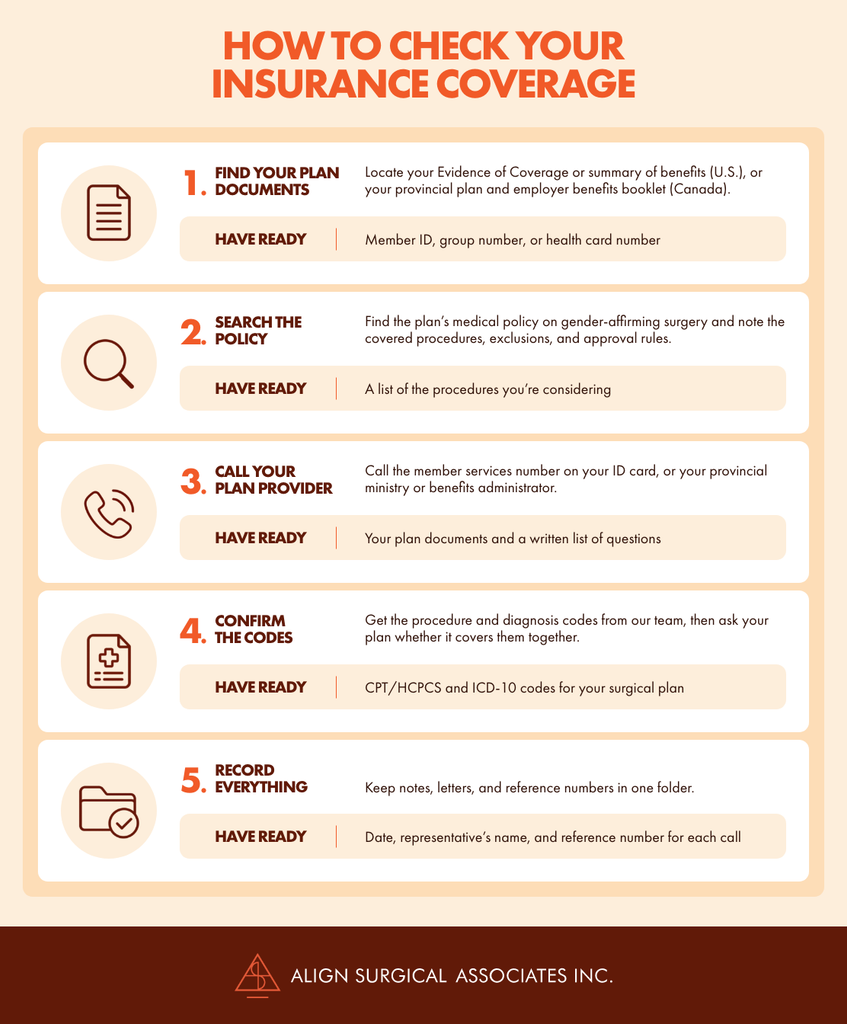
How Do You Check What Your Plan Covers?
Start with your plan’s written policy, then confirm the details with the people who administer it. In the U.S., look for your Evidence of Coverage or summary of benefits, search for your plan’s medical policy on gender-affirming surgery, and call the member services number on your ID card. In Canada, your provincial health ministry and your employer’s benefits administrator are the places to begin.
Ask whether surgery for your embodiment goals is covered, whether your surgeon is in-network, and whether approval is required. We recommend that you request your answers in writing or note the date, representative, and reference number if you call. After your consultation, our administrative and financial team will review your insurance information and explain what documentation we need from you.
What Are Billing Codes, and Why Do They Matter?
Billing codes tell your insurance provider what procedure you are seeking and why it’s needed for both approval and billing purposes. A procedure code (CPT or HCPCS) identifies the surgery itself, while a diagnosis code (ICD-10) records the reason for your care.
Our team can let you know which codes we expect to use for your surgical plan, so you can ask your plan whether the procedure and diagnosis codes are covered together. Provincial plans keep their own lists of insured procedures, so we encourage our Canadian patients to ask which listing applies to their surgery.
Whether you’re navigating the American or Canadian system, we recommend you keep a copy of the codes alongside your notes so you can compare them with any approval letter or explanation of benefits that arrives later.
What Is Prior Authorization, and How Does It Work?
Prior authorization means your plan reviews and approves a procedure before it happens; in the Canadian system, this is also referred to as “prior approval.” Your plan may require letters of support, clinical records, or other documentation supporting medical necessity. Separately, your surgical team may require medical clearance, lab work, or documentation from your hormone prescriber, when relevant. Our step-by-step process outlines what you may need and what you can expect before surgery.
It is important to remember that review times vary by plan, and approval does not necessarily guarantee payment.
What If Coverage Is Denied or Only Partial?
An insurance denial isn’t always final. Start by asking for the reason in writing, and save every letter and reference number, since they become the record for any appeal you make.
In California, a health plan must explain a denial and tell you how to file a grievance. If your plan is regulated by the California Department of Managed Health Care (DMHC), you can contact the DMHC Help Center for assistance. Do so if you disagree with your plan’s response to your grievance or your grievance remains unresolved after 30 days. For urgent issues, contact the Help Center immediately. Depending on the reason for the denial, you may qualify for an independent medical review, in which outside clinicians review the plan’s decision. The DMHC’s guide to gender-affirming care explains your rights.
Canadian patients can ask their provincial ministry about its review process. For costs that insurance doesn’t cover, we work with third-party financing providers to help you pay for your procedures over time.
Take the Next Step
Whether your coverage comes from a U.S. plan or a Canadian provincial program, our gender-affirming surgeons and care team are here to help. To get the most out of your consultation, we recommend coming prepared with your questions, supporting documentation, and whatever details you have about your insurance plan.
Get started today by requesting a consultation using the online form or calling Align Surgical Associates at (415) 530-5335.