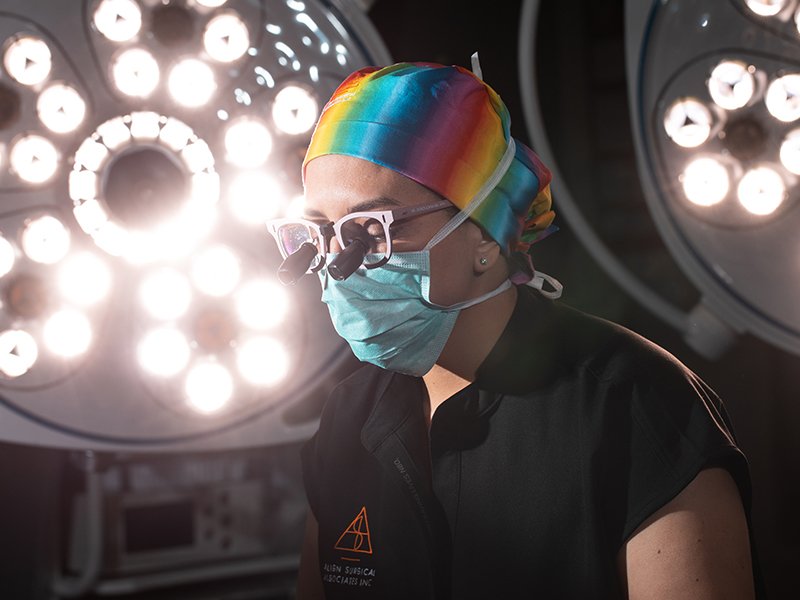
The story of how and why I became a gender-affirming surgeon is deeply rooted in social justice advocacy, fine art photography, global health, plastic surgery, and the “American Dream.”
It surprises many people to learn that I attended Catholic school until I started college. I think this is because parochial schools are not historically known for embracing “liberal values.” However, I credit my early education for instilling a deep sense of social justice in me, or at the very least, awakening it. At its very core, it taught me to have radical compassion for others, particularly those marginalized by society, and urged me to take action.
Fine art photography came into my life when I was a teenager. I still remember it was a rainy afternoon in Los Angeles when a friend took me to see a retrospective of the photographer Diane Arbus. Arbus photographed individuals with abnormal physical traits, mental disabilities, or other characteristics that marked them as social outcasts. Her remarkable ability to connect with disenfranchised individuals allowed her to visually reconstruct their social narratives through photography. My fascination with navigating – and ultimately reducing – the space between who someone is and how they appear became the scaffold upon which my future dream of becoming a gender-affirming surgeon was built.
Pursing a master’s in global health equipped me with invaluable skills in systematically addressing health inequities and using research as a tool for social justice advocacy. As the culmination of my studies, I gathered and analyzed data on the violent experiences of trafficked and non-trafficked sex workers in Eastern Europe. From acid throwing to gang rape, the women’s narratives revealed explicit physical, sexual, and psychological mutilation. Already devoted to the power of visual reconstruction through photography, I understood my desire to revise physical stigmata as a vocational call to plastic and reconstructive surgery (PRS).
After graduating from medical school in 2017, I had the privilege of training at an academic center specializing in gender-affirming surgery (GAS). While GAS has since been increasingly integrated into standard plastic surgery curricula, it was (and still is) rare for PRS trainees to have such high-volume exposure to the full spectrum of GAS. Providing lifesaving, life-giving care to transgender and gender diverse (TGD) individuals over the course of six years solidified my desire to become a GAS surgeon.
As the daughter of immigrants and the first in my family to be afforded the opportunity to pursue higher education, I hold a strong belief in the “American Dream” of self-actualization. In my mind, GAS is a direct extension of the “American Dream” in the sense that individuals have the right to be who they want to be—or rather, who they know themselves to be. For me, serving the TGD community exclusively through GAS in an affirming, BIPOC-queer owned practice that is over 95% insurance-based feels like I’m living my own version of the “American Dream,” while at the same time helping facilitate that dream for others.