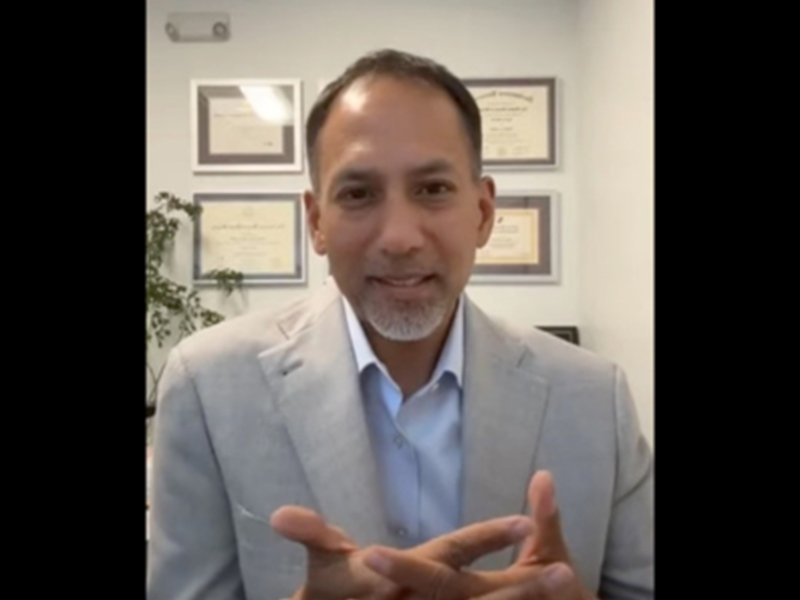
Dr. Dev Gurjala, a board-certified plastic surgeon, hosted an Instagram Live discussion on surgical innovation and single-scar phalloplasty, addressing pre- and post-op concerns and answering frequently asked questions.
https://www.youtube.com/watch?v=z_z2uuAFcdECaption/subtitle instructions: To turn on subtitles, turn on closed captioning (CC icon), located at the bottom right of the video. To change the language, go to settings > subtitles/cc > auto-translate. Then, select your native language.
Thank you for watching!
Dr. Dev Gurjala:
All right, well hello hello everyone.
My name is Dev Gurjala and I’m a surgeon at Ali Surgical Associates. Welcome to our live Instagram—we’re so happy to have you here and I’m really happy to be talking with you. Just a quick note, we have turned off the comments for this live session. That’s just to prevent any harmful commentary, but please feel free to submit questions using the question button. We’ll be happy to answer them throughout the talk and we’ll leave some time at the end as well to answer any questions. So with that, let’s dive in.
Again, my name is Dev Gurjala. I’m a board-certified plastic surgeon. I’ve been in practice for 11 or 12 years now and I’ve been doing gender-affirming surgery for 11 of those years. I joined Ali Surgical Associates in 2019, so I’ve been here for six years. We are a multi-surgeon group offering surgery in all aspects of gender-affirming care for trans, non-binary, and gender-diverse people.
I myself am happy that I’m able to offer the full spectrum of gender-affirming procedures—masculinizing, feminizing, non-binary procedures. My particular area of interest is in phalloplasty, and that’s what I’d like to talk about today.
So our topic is innovation in phalloplasty. I’ll cover a little bit about how the procedure works, how it’s been done in the past and currently, and then the new things that we’re working on here at Ali Surgical. Again, feel free to ask any questions and we will start right in with this topic.
Just to note, I’ll be showing some images here and a couple of them will be medical in nature of course, so just be aware of that.
To begin, one of the questions that people always have on their minds is: how is phalloplasty even done? How, as a surgeon, do we create a new phallus? I’d like to show you a picture here which illustrates that.
All right. Hope you can all see that. So the idea—you know, many things in surgery are complex—but the basic idea is very simple. What we try to do is get a rectangular section of tissue and simply roll that into a cylinder. Now if this is a phalloplasty where a patient is wishing to pee from a standing position, then we do what’s called a double roll. So it’s actually one roll which makes the urethra and then a roll around that which then makes the body of the phallus.
That is the basic idea. Now that piece of tissue that we pick up is called a flap—that’s just the term that we use. This rectangular piece of tissue or flap can really come from many places on the body. It can come from the groin area, from the arm, from the abdomen, but the two most commonly used sites are the radial forearm and the thigh. These are commonly referred to as a radial forearm free flap and the anterolateral thigh or just thigh flap.
These really form what are called the gold standard of how phalloplasty is done. Most of the time, radial forearm phalloplasty is done using the radial forearm free flap and it’s been done that way really for decades.
There are some drawbacks or disadvantages of doing it this way. In my view, the biggest of these is the amount of scarring that patients have to accept when they have this radial forearm free flap done or the thigh flap.
If you can see these pictures here—obviously, I’ve blocked out any sensitive areas with the black box for this live session—but what I’d like for you to see here is the amount of scarring.
The picture on the left is a radial forearm free flap, and that shows the typical amount of scarring you get. You’ll have it on the arm, and that comes from the tissue that is actually used to make the phallus. Then you see there’s another, second area of scar, and that’s on the thigh. That is from where a skin graft is usually taken.
A skin graft is just a really thin shaving of skin, and that skin graft is then used to cover the forearm. You have to do that because you can’t have just an open area there.
So what that means is that you end up with two relatively large areas of scarring.
Now, if you look at that left picture, there’s also a third scar in the groin area—that’s made to access the vessels. So there are really three scar sites.
Now, same thing with the thigh. You see that area on the left thigh where there’s a section of tissue missing—that was the rectangle used to make the phallus. And then again, on the other thigh, you see that area where the skin graft was taken from.
Again, that’s necessary—that shaving of skin—in order to cover the donor site, or the site where the tissue came from that was used to make the phallus.
Once again, there’s sort of a third scar. If you look in the groin area, there’s a line connecting the donor site to the area where the genitals are. That’s a scar which is needed to access the vessels.
So the point is that the way phalloplasty is done very commonly means that there will be a fair amount of scarring for the patient to accept.
So when I was first thinking about doing gender-affirming surgery, I saw this and I really wished, oh my gosh—is there some other way we can do this so that patients don’t have to accept so much scarring?
And so I began thinking about that and I had been thinking about it from about 2013 and planning for about eight years for how we can have a different approach to this so that patients can have less scars. So that’s kind of been my mission, my drive, my dream to come up with a way of doing this for our patients.
Let me show you this next picture here. Okay, so there is a technique in plastic surgery which is called tissue expansion. That’s basically the idea of putting in what’s essentially a water balloon under the skin and then slowly inflating that water balloon over time to stretch out the overlying skin.
What happens there is that you get more skin to work with and you also increase the blood flow to that area of skin, and that makes that flap very strong and less likely to undergo what’s called necrosis—or the tissue not surviving if it does not get enough good blood flow.
So tissue expansion has two really big benefits: giving more tissue to work with and then giving that tissue a stronger blood flow. This is used most commonly in breast reconstruction surgery, so it’s done many thousands of times all over the world because a lot of women need this surgery.
So an idea was: can we adapt this technique—tissue expansion—to phalloplasty and use it to create more tissue so that we have more to work with and less scarring at the donor site? Let me show you what that looks like.
Okay, this is one of my patients here who has undergone this technique of using a tissue expander in the thigh. What I thought would work well is to do tissue expansion in the thigh, not the forearm. If you try to expand the forearm, the skin is going to be very thin and probably would not work, so the thigh seemed like the ideal site to try this.
This is my patient who has undergone tissue expansion, and this occurs over a period of about three months. That’s necessary because you don’t want to go too fast; you can stretch the tissue and cause blood flow problems. You need to go slow and give the tissue time to accommodate and stretch and actually increase in surface area.
This is what it looks like after the tissue expansion is complete. Now, if you notice there’s a second thing there—you see that tube running along the top of the leg—and that is actually an area where we’re also trying to make the urethra, or the area that you pee through. We’re trying to make that at the same time as we’re doing the tissue expansion.
If it’s not clear what you’re looking at, this is a side view of somebody’s leg. Towards the left is the hip, and towards the right is the knee. This is what it looks like after you’ve stretched out that skin using tissue expansion.
So next is: what does it look like?
This is a picture of that same patient after they’ve gone through these techniques, and what I’d like for you to see here is the amount of scar.
It might be hard to see on your screen if it’s small, but if you look at the right thigh, you’ll see the donor site—that’s where we took the tissue to make the phallus. If you look really closely, there’s a thin scar going from about the hip down to the knee.
But the point is—you have to look pretty closely because it’s healed really nicely. What we’ve been able to do, because we expanded the tissue, is actually close the site as a single line and not need that skin graft from the other thigh.
So again, we’ve stretched out the skin, picked up our rectangle, and then closed that original area with just a single-line scar.
Also notice how the patient is posed—they have their forearms facing out—and that’s to show that there are no forearm scars, like you might have with a radial forearm phalloplasty.
This technique is what we call Single Scar Phalloplasty, and it’s an innovation we’ve developed here at Align Surgical. We’ve been doing it for a few years now, and we’ve shown that it allows us to do phalloplasty with much less scarring.
I hope you can see that clearly in this picture.
Let me share this next image—it’s a comparison of single scar phalloplasty versus a typical radial forearm flap. You can see there’s much less scar in the single scar approach.
That’s the innovation we’ve created and that we’re now offering to patients.
I’m not aware of any other surgeons or practices currently offering this technique. It’s new, and we’re still learning from every case and making it better and better. But my hope is that this represents a significant step forward—a version of phalloplasty that’s nicer for patients, because they don’t have to deal with as much scarring.
A couple more images here I’d like to show you.
Let’s talk a little bit about the staging of how this is done. Because tissue expansion takes about three months, there’s an extra step required with Single Scar Phalloplasty.
The first stage is placing the tissue expander—the water balloon—and stretching it out over three months. Once that portion is complete, the next steps are very similar to other phalloplasty techniques. You actually make the phallus in one stage, and then the subsequent stages include refining the phallus—meaning creating the glans, creating a scrotum, and finally placing implants for erectile function and to complete the scrotum.
So that’s what the staging looks like.
As a quick aside, there’s another innovation that we’re working on. That is the idea of using the abdomen as a donor site and combining that with tissue expansion.
So instead of placing the tissue expander in the thigh, we place it in the lower abdomen. We can then use that to stretch out the tissue in that area and make a phallus, and once again be able to close the donor site as a single line scar.
The goal is the same: minimal scarring and avoiding the need for a skin graft.
That’s something new we’re developing—another version of Single Scar Phalloplasty.
I’m seeing a bunch of questions coming in, so let’s start covering some of them.
One question I see here is about sensation.
How is sensation with Single Scar Phalloplasty?
Now, when you compare it to the radial forearm technique, the general belief has always been that the radial forearmprovides the best sensation.
But one of the things we’ve discovered as we’ve been doing Single Scar Phalloplasty more and more is that you can get the main branch of the nerve leading to that area of skin very reliably.
When you hook that nerve up—just like you do in a radial forearm phalloplasty—you can get really good sensation.
Because of how we are harvesting the tissue from the thigh, we have access to that main branch, which can then provide sensation to the new phallus.
So far, what we’ve found is that sensation is very good, and many of our patients are able to achieve orgasm just by stimulating the new phallus itself.
We think sensation is actually very good with Single Scar Phalloplasty.
Now, it does need to be said that sensation is always a little bit unpredictable.
At the time of surgery, we do our best to connect the nerves precisely and delicately—but after that, it’s up to the body. It depends on how that nerve grows and what final sensation the new phallus actually gets.
So it can range from full sensation along the entire length of the phallus to partial sensation, but most of the time, it is very successful.
Another question is: Who is a good candidate for a Single Scar Phalloplasty?
Well, the idea is to be able to offer it to as many patients as we can and, you know, not have any barriers to getting this type of surgery.
One thing that I found helps is if the body fat percentage is low, because one criticism of the thigh flap is that if it’s thick, when it’s turned into a phallus, that that phallus can actually be too large—that the diameter of that phallus is too great.
So that actually has helped a little bit by the tissue expansion, because the tissue expansion thins out the thigh flap—the thigh tissue—and that thinner tissue then actually behaves a little bit more like a radial forearm, which is good in that it’s thinner and can be tubularized into a more appropriately sized phallus.
So that’s why it helps if your body fat percentage is on the lower side, but the tissue expansion will further thin that flap and make the aesthetics of the phallus even better.
Other than that, you know, these are big surgeries, so it helps that patients are generally healthy, which most of our patients are.
So, again, the idea is we want to be able to offer this procedure to as many people as possible.
Now, I have in the past actually done liposuction of the thigh to prepare people for Single Scar Phalloplasty, if their body fat percentage isn’t on the low side, and that has worked. So if you ever wanted to discuss that, then we could discuss that together.
So, you know, it’s really important that potential patients understand that phalloplasty is a very complicated surgery, and it’s because of that there are things that can go wrong.
So there are sort of generic risks of surgery, which are things like bleeding or infection, but specific to phalloplasty, there are kind of two broad areas again.
One is scarring and wound healing complications, and the other is urethral complications.
So urethra is, again, the tube that one pees through. So things that can happen with that tube are that it can form a stricture, meaning a narrow point. So it can be hard to pee through that narrow area.
Another thing that can form is a leak, and that’s called a fistula. So you can imagine, if there is a leak in the tube that you pee through, that means that urine can come out not through just the tip of the phallus but through anywhere along the length of that urethra.
Usually it’s at the base of the phallus, most commonly. And that can be very disheartening. It can be disconcerting, and that’s definitely a complication.
So that’s something that can be fixed. It’s called urethra repair, and that’s another thing that we offer at the practice. So if you have that, then that’s another thing that you can come to us for, that we can try to fix for you.
But those are probably the biggest areas of complication in phalloplasty—again, having a stricture or a leak.
So, let’s see. Another question I’m getting here is:
What is the recovery like for phalloplasty?
Well, you know, when you’re doing the tissue expansion, you are able to walk around, do your normal day-to-day stuff—cook food, go to work—but we don’t want you doing anything that’s too strenuous. No heavy exercise or nothing that can actually cause trauma or injury to that area of tissue expansion.
You know, there’s going to be kind of a big bulge on your thigh, so obviously you want to be careful with that and not fall off a bike or unintentionally hit it with something. So some care is required, but you’re not confined to bed or anything like that.
Again, you’re going about your day normally. You may want to be wearing loose sweats and that kind of thing to cover the area, but many people do desk work—desk jobs—just fine.
Then when you actually come for the second stage at the end of your three months of expansion, then that is a bigger surgery. That requires a stay in the hospital.
I usually keep my patients in the hospital for about a week to make sure that the blood flow is good to the phallus.
Then after that, the rest of the procedures are largely outpatient procedures, meaning you come and you go home the same day. And that’s for things like, again, aesthetic refinement—glansplasty, scrotoplasty—and then for placement of the implants.
So, you know, all in all, it takes a few months to actually create and, you know, have the phallus made for you—about five months from stage one to being healed with a new phallus.
So that’s not a short amount of time. And then for these subsequent stages, those we usually spread out over the course of one to two years.
So it’s really important to know that when you choose to have phalloplasty, it is a commitment, and it does take time.
If anybody has questions, they can be—feel free to submit more. Let’s see.
I’m getting some other questions here about other procedures that are offered. So I’m really privileged to offer all other types of surgery in gender affirmation.
I especially like doing facial feminization and top surgery—or chest masculinization—or non-binary chest procedures.
So actually my next topic for Instagram Live will be discussing top surgery and all the things to look for when you’re choosing a surgeon.
Any other questions that we have that have come through? Yeah? Okay. Let me just check one more time here.
Oh, okay, thank you. So one other question is about insurance.
Thank you to the person who asked that. So phalloplasty—and even the technique that I’m offering, Single Scar Phalloplasty—is covered by insurance.
So it’s very important to check with your plan whether they offer gender-affirming benefits. If they do, then phalloplasty will be covered.
At Align Surgical, we have a really robust and experienced insurance team, and after you have a consultation with me, our team will work with you to help you navigate through all the insurance challenges that there can be.
But what we can say for sure is that every case we’ve done so far has been covered by insurance once we get through the process.
So that’s not something I want my patients to really stress about.
Now, if you don’t have insurance, then it is indeed very expensive. But what we encourage you to do is to find insurance. You can get insurance through Obamacare and other insurance programs, and it really does help to have that in order to get phalloplasty.
Let’s see, there’s one more question about removing breast implants. I’m not quite sure what the original question was for that, but, you know, a procedure that we do is breast augmentation for gender affirmation.
And let’s see here—if a patient needed those breast implants removed for any reason, that’s definitely something that can be done.
Sometimes people want to upsize implants or downsize implants. Other times, people, you know, want to have a more masculine-appearing chest and therefore tissue can be removed.
So those are all things that we offer.
So that’s bringing us to the end of our half hour here. I hope that that was useful for you all, learning more about phalloplasty and the innovations that Align Surgical is offering.
I’m very happy to meet with any of you to talk in more detail about Single Scar Phalloplasty, so if you’re interested, please just email us at alignsurgical.com or give us a call, and we will be super happy to set up a consultation with you.
With that—take care, everyone, be safe, and hope to meet you in person. Thank you all so much.