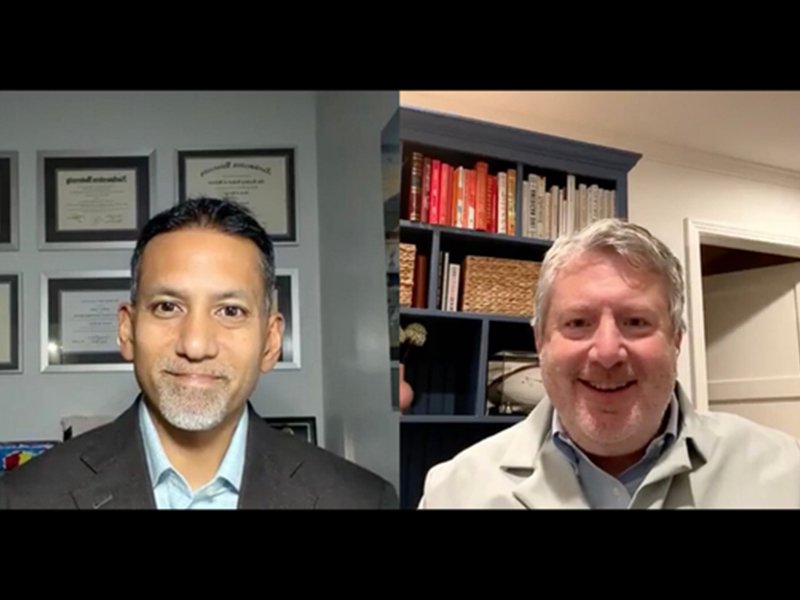
Drs. Dev Gurjala and Michael Safir of Align Surgical Associates recently hosted an Instagram Live session focused on single scar phalloplasty (SSP) and microvascular phalloplasties, and how to know which is the right procedure for you. Throughout the discussion, both surgeons clarify what SSP and microvascular phalloplasties entail and answer the most common concerns patients express.
Caption/subtitle instructions: To turn on subtitles, turn on closed captioning (CC icon), located at the bottom right of the video. To change the language, go to settings > subtitles/cc > auto-translate. Then, select your native language.
Thank you for watching!
Dr. Dev Gurjala: Hello everyone. Thank you so much for joining us for our discussion today regarding phaloplasty. My name is Dev Gurjala. I’m one of the surgeons at Align Surgical Associates and I’m joined by Dr. Safir, one of my co-surgeons and colleagues, who also performs phalloplasty at Align. Our goal today is to talk about the different types of phalloplasty that we offer at Align Surgical Associates. Dr. Safir, do you want to start out by telling people a little bit about your background?
Dr. Safir: I’m Michael Safir. I’m a reconstructive urologist. What that means is that I trained in urological surgery and did additional surgical training in male and female reconstructive urology, reconstructive genital surgery. I’ve been doing exclusively transgender and non-binary surgery for eight years now, and I only do bottom surgery.
Dr. Gurjala: Excellent. Just to note to everybody that we have turned off the comments for this live stream just to make sure that nothing harmful comes across in the comments, but please feel free to ask questions using the question function which should be on the lower part of your screen, and we’ll be happy to answer questions as we go through the Instagram Live.
Just a little bit about my background: my name is Dev Gurjala. I’m a board-certified plastic and reconstructive surgeon. I’ve done a fellowship in microsurgery, and I also have a master’s in engineering design and innovation. I’ve been in practice since 2013 doing gender affirming surgery and and now I do it full-time since joining Align Surgical in 2019. I’m very lucky to be offering the full gamut of gender affirming procedures from head to toe including face, chest, bottom surgery and body contouring. My passion in particular is combining surgery with principles of design and engineering hopefully to think of new ways of doing surgery and and to innovate within gender affirming surgery. So that’s a little bit about my background. Dr. Safir, do you want to tell people about the type of phalloplasty that you offer?
Dr. Safir: Sure. Thanks Dev. So, we offer a variety of different phalloplasties. The two most common ones that we do are radial forearm phalloplasty and alt phalloplasty. They’re microvascular procedures. We’ve done a little over 200 of these, and we do them in one stage. I work with two great micro surgeons and the operations that we do typically when they start around 7:30 in the morning are done around 1:30 in the afternoon. Like I said, we try to do everything in a single stage, and for us that means making the phallus, making the scrotum, doing the entire urethra, artery, vein, nerve hookup, and we we’ve made some significant – I call them – micro revolutions over the course of the last eight years, and important step-by-step improvements that we’ve learned, lessons we’ve learned and I think that’s helped us to deliver a really good operation in the year 2025. I think 2026 the operations will be even better.
Dr. Gurjala: That’s great Dr. Safir. These are really considered the the gold standard techniques for phalloplasty in our current day and age. Is that right?
Dr. Safir: Yeah. Worldwide radio forum phalloplasty has the longest run. It’s been done for the longest period of time and so we have tons of information about it from multiple centers. It’s just called the gold standard not necessarily because it’s the best but it is the operation that when we make other innovations we compare them against the radio forearm phalloplasty but there are so many different options that are available to patients and we know it can be confusing – everyone calls a stage of a procedure, something different. The operations are done differently depending upon the practice that you’re at. So hopefully today we can clarify a little bit about that or maybe just explain and hopefully you figure out something you didn’t know before. I’m sure the questions will be good.
Dr. Gurjala: Excellent. And, it really sounds like the technique you offer has benefited from from decades of refinements over the years.
Dr. Safir: Yeah. The operation at its infancy was done there’s one way to do it. When you’re learning something, you only do it one way because you have to really get good at it and then be able to show that there’s benefit. I think as time goes on, as we get more experienced with the procedure, we feel comfortable designing tailored or bespoke methods of doing the operation that are a reflection of what the patients want. Because what we’ve discovered, what I know is that everyone has their own brand of gender dysphoria and that makes patients seek out particular types of operations hopefully that are designed to make changes that they want and not make changes they don’t want. So I think over the last five years we felt a lot more comfortable individually designing operations for what our patients are asking us.
Dr. Gurjala: That’s great. Thank you. I’ll say a little bit about the technique called single scar phalloplasty (SSP). This is a technique that I’ve been working on for just about eight years since sort of thinking of the idea maybe even closer to 10 years and about five or six years actually in practice trying to develop this procedure and single scar phalloplasty was really born out of a desire to try and reduce scarring in phalloplasty and to confine the scar to a single incision along the thigh or the abdomen. They’re kind of two different donor sites that we can use to create the new phallus, either the abdomen or the thigh. The idea is to stretch the tissue out before the tissue is actually moved and to use that to do that stretching using a tissue expander so that after you’ve created the surface area of tissue that you’re going to use to create the new phallus, you have enough tissue left over to actually close the incision as a single line. So that’s the whole idea behind single scar phalloplasty that tissue expansion can be done in the thigh or the abdomen. One of the big differences between single scar phalloplasty and radal forearm or conventional ALT is this tissue expansion period. So the tissue expansion adds an additional stage. Stage one is placement of the expander followed by 3 months of a tissue expansion. But what you get from that is that reduction in scar. We’ll go into a little more detail about these procedures but that’s what single scar is in a nutshell. It’s an attempt to provide an option to patients which perhaps offers less scarring.
Dr. Safir, do you want to go into a little bit more detail about radial forearm and ALT and maybe talk about some of the refinements that that have been made over the years?
Dr. Safir: A lot of our patients travel to have the surgery done from other states, other countries, and so what we’ve tried to do is to deliver an operation that can be done in a single stage with a limited hospitalization for the entire procedure. It’s our hope after doing a radial forearm phalloplasty or ALT that when we’re done with the surgery, all the patient needs as a second operation is a glands plasty and then implants done. I think the difference of the procedure that we do, we work with two microsurgeons and me. We operate all at the same time, and it’s this complex choreography of procedure that allows us to all be in the operating room, all operating at exactly the same time. I think what that’s done is it’s allowed us to do an operation that ordinarily would take 14 hours, you know, starting early in the morning and finishing in the evening and doing it in under seven hours. I think there’s a benefit for being on the operating room table as little as possible. I think benefit from avoiding repeated exposures to general anesthetics, and like I said, it allows our patients to come into town, have their operation, stay – like I said – 5 days in the hospital and then just a few weeks afterwards. And just to speak a little bit about the micro revolutions that we’ve made, we’ve made improvements in the most critical area of the operation which is the area that unfortunately is associated with complications – the urethra. So we’ve made refinements in how we reconnect the urethra to try to avoid stricture and fistula which are the two most concerning complications after surgery. We’ve made changes in how we design the urethral hookup. We’ve made advancements with the microsurggeons to try to preserve as much robust blood flow to this critical area to establish blood flow that is going to be durable and will heal with minimal scarring. Along with that, we’ve made significant improvements in the cosmetic results, significant improvement in the functional results, and I think it all prepares a patient for the ability to have implant surgery as soon as nine months after the initial phalloplasty.
Dr. Gurjala: Just to give you all a little bit more sense of what single scar phalloplasty is, it involves an additional stage which is that first implantation of the tissue expander. Along with that, I also do a graft of the vaginal lining into the thigh as well in the form of a channel. That’s to create the neourethra. We’re doing two things at the same time: creating a neourethra in the thigh as well as placing the tissue expander to stretch the tissue out. Both of those will occur together over that 3-month period where we’re stretching the tissue and forming that new urethral channel. By the end of three months, you’re ready for stage two. That’s when we create the neophallus by moving the tissue from the thigh into the pubic area. That surgery allows for creation of the shaft placement of the new urethra in its new location, closing of the thigh. What that means is that it does necessitate an additional stage versus the rate form free flap or conventional ALT. What you get from that is a reduction of scar. Because you’re able to close the thigh incision or abdominal incision as a single line, what that means is that you avoid having to take a skin graft from the other thigh. You’re avoiding two large areas of scar: one from the skin graft and one from the donor site where you took the tissue. Once you’ve gotten to stage two and created the new phallus, the remaining steps are similar where you do a glansplasty and a scrotoplasty and eventually once sensation has come in, typically about a year or two later, you can place the erectile device. I hope that gives you all a sense of the staging for single scar phalloplasty.
Any other things that you would like to say about radial forearm, Dr. Safir?
Dr. Safir: I think in general, even though we do a lot of these procedures, they’re complicated and it’s important for you to give a lot of thought to what your needs and wants are. We’ve done the procedure in all permutations and combinations of patients who want scrotoplasty, patients who don’t, patients who want vaginal preservation, patients who want vaginectomy, patients who don’t care about standing to pee and patients where it’s important to stand to pee. So, I think the best thing to do is to just make sure that you verbalize to your surgeon exactly what you’re looking for. Really there’s no best procedure. One of my mentors said the best procedure is the best operation in that surgeon’s hands. I think that when you find out what your doctor is offering you as a patient, just make sure it coincides with what your needs are. The patients who I see typically, they want to start peeing right away and they want to start peeing right away out of the tip of the penis. What we aim to do is to enable them to start their voiding trial two weeks after their phalloplasty. In patients who really want to get to voiding as soon as possible, radial forearm or conventional ALT phalloplasty may be the best option for you. I think patients understand after a consult what their surgeon is offering them and just make sure that it gels with what you’re looking for.
Dr. Gurjala: That’s a great point, Dr. Safir. These are patient-tailored procedures where our goal is to understand what you’re looking for and what will help treat your dysphoria the best for you. One of the broad distinctions is whether you want urethral lengthening or not for the neophallus. So if you opt not to have urethral lengthening, we kind of call that a shaft-only phalloplasty and the goal is to create an anatomic appearing neophallus, but one where you don’t void urine through the tip of the phallus, and in that case, you would sit down to void urine just like you normally would. That’s called a shaft-only phalloplasty. The other version of that would be with urethral lengthening where the objective is to allow for peeing while you stand through the tip of the of the neophallus. Like Dr. Safir said, all the other aspects of the general area can be tailored whether we do a glansplasty, a scrotum or close the vaginal canal or not. So those are all different variations of these procedures.
Dr. Safir, can you tell us about how many of these procedures you’ve you’ve done?
Dr. Safir: Well, I started doing surgery in 2017, genital reconstructive surgery for the transgender community. And early on we were doing around 65% radial forearms and about 35% conventional ALTS and we’ve done around 200 of them. I think it’s allowed us to do them in all combinations. Patients are really vocal now about what they’re looking for and so I think it’s really important that we establish size of the phallus. There are just so many concerns that patients have and of the 200 operations the majority of them are patients who are looking for everything and most of the patients who are seeing me are patients who want to get everything done at once. Either for geographic reasons or they just want to start peeing right away. So, all of our refinements have been done to try to establish that we can do it all at once. Try to shorten the duration of their stay in the hospital, try to make the first three weeks after surgery the critical time during your recovery to make that as simple as possible and to anticipate the needs of the patient. I do recommend that all patients see more than one surgeon. It’s really important. Thankfully, we’re all busy doing surgery, so none of us are offended when patients see other doctors. In fact, I think it’s important you gel with a doctor or you won’t. You’ll hear something during the consultation that doesn’t make sense to you. Get a bunch of consultations, be vocal about what you want, ask questions that are particular and don’t move forward with surgery until you’re sure that you’re with the right surgeon. I think that is such an important point which is to have several phalloplasty consultations with different surgeons because it’s important that you inform yourself of what’s out there and available for you, and that you make an informed decision. That’s really what it’s about, so that whichever surgeon you choose, you have open eyes into what the technique is, what the experience is, what their experience is, what the risks are, what special things that particular surgeon might be doing.
Dr. Gurjala: I too encourage patients to see Dr. Safir or anybody else even outside of Align Surgical. You should really know your options. For example, one reason that’s important is for a single scar phalloplasty I’ve done about 30 of these procedures so far. And that indicates that it is definitely something new. This is a new procedure. It’s really important to me that coming into doing surgery with me and that be part of your decision-making process. If you are looking for something which has the advantage or trying to reduce scar it is a newer technique. So, it’s important that walking in we actually have a question which has come in here, Dr. Safir, talking about sensation in phalloplasty. Do you want to talk a little bit about what that’s like for your procedures?
Dr. Safir: I’d love to talk about it. One of my favorite things to do in the operating room is to find a nerve that is going to conduct sensation. Not only fine touch but erogynous sensation. There are two nerves on the patient’s current phallus that are candidates and I think one of the things that has improved certainly for my patients is I think that we are doing a much better job of isolating the nerve, doing a much better job of keeping the nerve pristine and not causing undue trauma to the nerve in the process of isolating it and preparing it for a microscopic repair. But the repair is only the first stage, right? After we do all of the hookups, it really takes a year to establish as full sensation as you’re going to get. Over 90% of our patients have sensation of fine touch and erogynous sensation. What’s interesting about the recovery is that you can plot out millimeter by millimeter, the weekly progression of sensation that you gain after surgery. It starts at the base. It makes its way to the tip of the phallus. And I think that’s for a lot of our patients a fascinating part of their post-operative journey. I think we’re doing a good job. Our micros surgeons are quite excellent at putting the nerves together. I think it’s really guaranteed setting up the patients for a successful outcome.
Dr. Gurjala: Dr. Safir, would you say there’s any difference in sensation between an ALT and radial forearm?
Dr. Safir: I think for a lot of reasons the radial forearm has better sensation. The reason for that there are a lot of factors. I think the heavier weight of the of the phallus with the ALT, the nerve in the donor whether it’s forearm or the thigh, they’re not identical nerves. The phallus in ALT is wider, thicker, in some cases longer and so I think a little bit more difficulty in establishing sensation to the entire phallus. I think either option we’ve had really good results.
Dr. Gurjala: For single scar phalloplasty, the expectation is also that patients achieve good sensation both light touch and erogynous sensation. One of the refinements that has been possible because of the single scar phalloplasty approach is that we’re hooking up the nerve in the tissue which creates the new phallus to the very same nerve that we’re hooking up to in rado forearm or conventional ALT. But the difference with SSP is that we can actually capture the main trunk of that sensory nerve which then supplies that whole region of the thigh. One of the things that can be difficult is accessing that main trunk. Often times what we can get is a more further down branch on the tree rather than the main trunk of the of the tree of the sensory nerve. So with the single scar approach because the incision actually goes high up on the thigh, we’re able to capture that main trunk and therefore get pretty good sensation to the new phallus. I’ve had many patients who are able to orgasm using the new phallus alone. So that’s great to see when patients get that sensation.
Dr. Safir, do you want to say a few words about how patients might choose between radial forearm and conventional ALT? Then I can talk about who might be attracted to exploring single scar phalloplasty.
Dr. Safir: Absolutely. I think there are some patients who simply do not want to use their arms for surgery as donor sites. I think that with the increased visibility of transgender patients, they’re concerned that they will be outed as a member of the community simply by someone seeing their forearm and the scar on their forearm. Many of our patients are able to cover this in wonderful ways with tattooing. But still there’s a group of patients who simply don’t want scars on their forearms or they have jobs that require, like concert violinists, or jobs that patients are concerned about the impact of recovery and rehabilitation afterwards. For patients like that, an ALT may be the better option. ALT phalloplasties are thicker, wider and in many cases may need downsizing either through liposuction, other forms of fat reduction and other methods of skin reduction. So most of our patients who are lean are good candidates for ALT. Patients who are carrying more weight than they would like, especially in the thigh and in the pelvis, may not be a good candidate. It isn’t so much a choice of a patient. It’s when you come into the office visit, we will examine you in a way that allows us a lot of insight into what is going to be the likely most successful version of your surgery and then together with shared decision making, we can decide how to proceed.
Dr. Gurjala: Thank you, Dr. Safir. And for single scar phalloplasty, the kind of profile of the patient who might be interested in this is somebody who is looking to avoid that radial forearm scarring, again, as you know, if you’re trying to remain stealth about your transition or just wanting to avoid the appearance of that scar, or if you might be a musician or an artist or do mechanical fine work with your hands, those are people who might want to avoid the radial forearm. What single scar phalloplasty offers is an alternative to that which also avoids the skin graft scar. If you’re wanting to avoid that secondary skin graft scar on the thigh and just have that one line of scar down one thigh that’s what single scar phalloplasty can offer. But part of that profile is also a patient who is comfortable with trying a newer technique because this is something which I’ve tried to innovate and where I’ve not done 200 cases like Dr. Safir has for right of forearm. One has to understand that this is something newer and that hopefully for you the benefit of having that decrease scar weighs heavily in your decision-process to go forward with with single scar phalloplasty.
I think we’re nearing the end of our time here, Dr. Safir. One of the things we wanted to tell all of you is that together we are so happy at Align Surgical to be offering this variety of phalloplasty techniques. We really consider ourselves trying to be state-of-the-art in what we’re offering with Dr. Safir for having had so much experience and so much time to refine his approach to radial forearm and ALT, and with my efforts to try to come up with new ways of of reducing scarring. We’re just happy to be serving all of you and offering these these cutting-edge procedures. Anything you have to say about that, Dr. Safir?
Dr. Safir: I would say go to our website and that’s not a marketing plug. There are tons of great photos in our gallery and you can see if those images resonate with you, and I think our website is designed to provide a ton of information about all of these operations and so it’s https://alignsurgical.com/, and I think if you go there you’re going to learn something and hopefully it’ll help you in your decision- making.
Dr. Gurjala: Speaking of learning, another way that we’re so lucky is that Dr. Safir and I get to work together and we are really excited about collaborating with each other and trying to help each other to be better surgeons every day. Dr. Safir is a reconstructive urologist who’s double boarded in male and female pelvic surgery. I learn from him all the time. I get to bounce ideas off him and have his input on the the new ideas I’m trying to come up with. Collaboration is just a strong part of who we are here at Align Surgical.
Well, we’re just at about 3 minutes over. I really hope that this has been useful for all of you. Thank you, once again, for for giving us your time and best wishes to you all. Thank you.