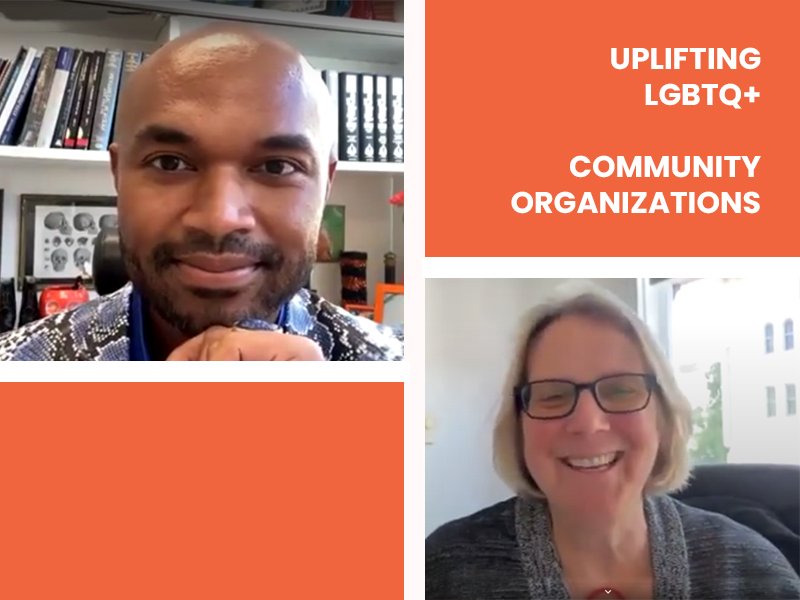
In this week’s vlog, Dr. Satterwhite sits down with SF LGBT Center’s Executive Director, Rebecca Rolfe, on Instagram Live to discuss how to uplift LGBTQ+ organizations and the LGBTQ+ community as a whole. Watch the video on-demand:https://www.youtube.com/watch?v=iDkR64m8yeQ
Dr. Satterwhite:
Hi Rebecca, how are you doing?
Rebecca:
I’m doing well, thank you so much. Sorry about that. I thought I had requested to join, but I think I was in limbo land.
Dr. Satterwhite:
No, it’s a pleasure and honor to have you here. I know you’re a busy person yourself and I’m definitely super, super excited that we can have this conversation. Once again, it’s all about uplifting LGBTQ+ organizations and the position that you’re in. You’ve done so much uplifting and lifting for the community, which we really appreciate. There are several questions that I wanted to ask just about your experiences, what you’ve been doing, and what you’ve seen over the years. Then we can also take the opportunity to have you ask me questions as well, and that’ll just kind of highlight the collaboration that we’re doing for the community.
So, one thing I wanted to ask you, Rebecca—can you tell us a little bit more about the San Francisco LGBT Center, the history, how it came to be, and what the center is prioritizing right now at this point in time?
Rebecca:
Sure, great, I’d love to. So, the Center’s been here for—we just celebrated 21 years. So we’re a relatively young organization, just kind of, if you equate organizations to people, just entering our adulthood. But we really were started at the height of the AIDS epidemic and really out of a desire to have something really lasting and meaningful and a true home for the queer community—the very broad and extraordinarily diverse community. And that’s really what we feel like we’ve grown into over the past 21 years.
We’re here to both celebrate and uplift all things queer—queer art and culture and voices and music and perspective—and also to make sure that every member of our community has the resources to be whole and healthy and full human beings.
We do have a lot of direct services, really working with folks who are experiencing a variety of ways that homophobia and transphobia and race and sex and gender and economics intersect in their lives. So we’ve got programs to help people. We work with a lot of young people who have come to San Francisco seeking a place of safety and sanctuary and finding it a hard place to live. We offer support for people finding jobs, starting and growing businesses, financial literacy and capacity building, health and wellness. So a lot of different resources that can really be blended and mixed to what any individual needs at any given time. And then also, as I said, a lot of celebration of community.
Dr. Satterwhite:
That’s wonderful—so many bases and so many levels of care for the community. And I think in many ways we should feel fortunate that we live in the San Francisco area and that we do have the SF LGBT Center. But certainly, there are issues. I think what I wanted to ask you is: how would you describe the state of the LGBTQ community in San Francisco right now? What issues are specific, do you feel, for the city?
Rebecca:
That’s a great question. I think San Francisco is a unique environment for the queer community. We have the best legal protections in the world here. We also have, in many ways, broad social acceptance for a lot of queer folks. I think also we find a lot of folks coming here seeking a place of safety and a place where they can be themselves, coming from very challenging backgrounds and experiences in other places.
One of the things that’s interesting is a lot of people think that in San Francisco, we’ve somehow magically conquered homophobia and transphobia and racism, and that’s just not true. We see the same types of economic and health and other disparities here for members of our community that we see across the country—from the ways that young folks in our schools experience homophobia and transphobia, and some of the educational outcomes and impacts that we’re seeing for queer and trans young people and non-binary young people—to the experiences of adults.
So I think it’s important to remember that even here in San Francisco, there still continues to be both the experiences that we’ve carried forward from the rest of our lives, but also the experiences that we have right here in San Francisco. And that we continue to see challenges every single day. That is less true for folks who are white and well-educated and cis and have a job and have a safe place to live. But when we really start looking at how—for trans folk, for trans women of color, for folks who don’t have a traditional education or have a harder time getting a job—we really see those challenges compounded.
Enormous challenges just to survive honestly, but to survive and live in a place like San Francisco. People talk a lot about “a tale of two cities.” It’s kind of that, even amplified a little bit more for the queer community.
Dr. Satterwhite:
I could totally imagine that. And then specifically for the transgender, the gender-diverse community—what programs and services does the Center have for supporting folks who are moving forward with gender-affirming care or trying to seek it?
Rebecca:
It’s a great question. In all of our work, we really try to center trans folk, non-binary folk, folks of color as sort of the center of the analysis. We figure that if we’re meeting the needs of trans folks, cis folks are going to get served too. It’s just the nature of how that works.
So everything we do, we try to really think about: what are the specific needs of transgender, expansive, gender non-binary folk? And then how do we really make sure that our services are built around what those needs might be?
In some cases, we really look at the very specific needs of trans folks. For instance, in our employment program, we know that there are some very specific barriers that transgender and gender-expansive folks face in finding and sustaining employment. So we’ve structured a program that—within our overall employment program—about 60% of the work we do is with trans and non-binary job seekers and really looking at addressing those specific barriers.
Also, our youth program—we see a lot of folks coming in who identify across the very broad and expansive gender spectrum and really want to make sure that those services are available.
We have some services that are very specific. We have a new program that a group of great folks started here at the Center called Fresh Starts that’s particularly for trans femme folk. It’s intergenerational. It includes folks who are just exploring where they sit in that spectrum, to folks who feel like they’re sort of elders in the community and can really share advice across both age intergenerationally but also just folks in very different places in exploring what that looks like for them.
We’re starting a new group for trans masculine folk. So some specific places and services, but also making sure that all of our services are really centering that. We know there’s a different set of what feels right for every person, so we work with everyone to look at: for each person, what is it that they need in order to feel whole?
If that’s medical—surgery, or other types of medical solutions—for some folks, that’s the right path. For others, it’s not. And we’ll work with them to support whatever that is.
We’re super fortunate to be in a place where we have services like Align and physicians like you who are really here to support the community and, I think, to create a really positive—and to use the term of our time here today—uplifting sort of opportunity for people who feel like that’s the solution that’s going to work for them.
So I have a couple of questions for you too, if that’s okay.
Dr. Satterwhite:
Oh, let’s—yeah, since we’re—it’s a two-way thing here, so I don’t—
Rebecca:
Well, my first question is just to be a little bit personal. I’m wondering how it is for—how did you get into this work? And then, for you—for someone who gets to be really a part of someone’s very important journey to really finding the solutions that feel right for them—what is it like to get to be a part of someone’s journey and to be such an integral piece of some really important steps that people are taking toward what feels like their happiness and their whole self?
Dr. Satterwhite:
Sure. I think we’re both doing the same things—we’re helping people on their journeys, right? And we’re trying to find what it is that they need, as you were saying, to allow them to continue on with that difficult journey.
For me, just from a personal standpoint, as far back as I can remember, I know I’ve always wanted to be a doctor—always wanted to be a surgeon—and I always knew that I wanted to work with people who needed the most help. I’ve always wanted to work with marginalized, disenfranchised people. It was just very important to me.
For the longest time, I actually thought I was going to be a pediatric transplant surgeon. I did my training at Stanford and then I met plastic surgeons there who were doing wonderful reconstructive work. Prior to that, the only views or thoughts that I had of plastic surgeons were what you saw on TV—cosmetic surgery in Beverly Hills—and there’s nothing wrong with that, of course. But that was just what I saw, and I thought, “That doesn’t really fit me.”
Then I saw these amazing reconstructive procedures they were doing. I was just in love. I saw a talk that Dr. Doug Ousterhout had given years ago about facial gender-affirming surgery, and I absolutely fell in love. He had this passion for the work he was doing. He loved his patients. It matched everything that I wanted to do.
I think for me personally, being gay, being Black, being Filipino—there have been a lot of struggles that I’ve had in my life that allow me to sympathize with the community. I do have my own set of privileges as a cisgender man, and I grant that I cannot 100% empathize with the struggles that so many members of our community have gone through, but I can certainly sympathize, and I can certainly understand and feel and know many of those struggles.
That definitely allows me to connect and move forward hand in hand with our patients. That wonderful talk I saw from Dr. Ousterhout, how I met all these other wonderful people at Stanford—Dr. Donald Laub, who was a pioneer in gender-affirming surgery and who died recently, which was quite sad. One of his collaborators, Judy Van Maasdam, took me under her wing. She had been heavily involved in WPATH and guided me along.
This was around 2010, 2011, when I really had my interest. It was ultimately in 2014 when I started performing gender-affirming surgery. It wasn’t that long ago, but even then, there weren’t any training programs. I couldn’t find anyone to work with. I was fortunate enough to meet another surgeon, and I joined him and spent time with him for about four years. Eventually, I went out into my own practice in 2018.
The work that I do feels like home. This is my comfort zone. I can’t imagine doing anything else. It’s interesting because I have patients who occasionally come in and ask for non-gender-affirming procedures, and I feel strange talking to them because I’m just not used to this. This is what feels so natural and what feels just right for me.
But it is a journey. It’s all about, as you said, Rebecca—listening. What is it that each person, each patient needs? Because everyone’s different, everyone is unique. I want to do whatever I can to celebrate that uniqueness—not to force my particular ideals on a patient, but to say, “Hey, I’m here to help you. What is it that you need? I will find a way to help you in this process.”
It’s just extremely rewarding, as you know, for patients to be able to have a positive experience in their journey, and they can reach out to other folks and guide people along as well. That’s what I like. It’s such a collaborative effort—that when you help people, they help other people, and then we all are united in that mission, which I think is so magical.
Rebecca:
That’s great. One of the things I was thinking about as well is that, because that’s 100% of what you do, I know one of the things we’ve experienced here is that many of the folks that we work with in the community have never received services elsewhere except from the Center. In spite of the fact that they’re fully eligible for services from a lot of different service providers, there’s something about coming to an LGBTQ-specific place.
I think that’s probably true for you as well—that there’s something about people being able to go to a place where they know that that’s what you do, that’s your expertise. Also, the assurance that they’re going to be treated with respect and care and appreciation and sensitivity—I think it’s really a different thing. So many folks in our community have not experienced that in medical settings and other places. To have a place where that’s your mission and your work—I think that’s really very special and very unique.
Dr. Satterwhite:
Yeah, and you’re right, Rebecca. I think, once again, for both of us, it’s about creating a safe place for our community. I’ve seen this many times where patients have had a history of having doors slammed in their face, of just being mistreated by doctors at a variety of healthcare facilities.
I want patients to come in and feel immediately comfortable and safe and welcome—where they can feel okay to be vulnerable, to let their guard down, to be honest, to know that things they’re going to tell me are not going to be used against them in any way. That they don’t have to put up a front, that they don’t have to make up a script in order to move forward.
That’s what I value so much, not just with myself, but with the other surgeons and the rest of my staff. It’s about creating this environment of safety so that patients can be honest with us and let us know about any medical issues, social issues, transportation issues—anything. If they’re homeless, just tell us. We’re not going to use that against you. We understand, and we’re going to do whatever we can and work with the community, work with you, work with other folks throughout the Bay Area to find the resources to help our patients move forward safely—safely with an operation.
Rebecca:
Great, great, that’s wonderful. I have one other question, which is—I know that sometimes medical care and intervention can be really expensive. And I know that you have a lot of resources to really ensure accessibility for gender-affirming surgeries for individuals from lots of different backgrounds. I’m wondering if there’s anything you can share with us about that as well, because I know that’s a question a lot of people have when they come to us: “How am I going to afford this? I know what I want—I don’t know how to pay for it.”
Dr. Satterwhite:
It is—and the financial landscape is quite confusing. It’s even confusing for me, and I’m in the midst of it. I’m fortunate enough to have our practice—just a team and employees who are dedicated 100% to working with patients to make sure the process is going to be very easy.
There are certainly other practices or centers where a lot of that burden is put onto patients, but we really want to make sure it’s easy when they’re working with us. I would say over 98% of our patients are under insurance. Half of our patients are under some type of public insurance—Medi-Cal or a variation of that. A lot of patients are under San Francisco Health Plan.
We really want to make sure that anyone, from any socioeconomic status, is able to move forward—and move forward without a huge financial burden. I would say that at least 60%, if not more, of our patients are patients of color. We have a very high percentage of patients who are African-American or Latinx as well. And I think that also reflects an underrepresented and underserved segment of the community that we definitely want to be able to help.
What we do is—for any patient who reaches out to our office—we ask them to let us know what insurance plan they have. Then we tell them: here are the steps you need to take. We are in-network with a couple of insurance plans. For others, we do what are called letters of agreement, where our team talks with the insurance company to come up with a one-time agreement with that particular patient.
We want to be as transparent as possible. If, for whatever reason, an insurance company doesn’t provide coverage—and insurance companies will throw all sorts of random stuff at you—we will fight. We will push back. We will appeal. I talk with the medical directors of those particular insurance companies.
We have several people who are also lawyers or attorneys who work with us—several of them for free—to help in that process. So we really have a system in place to move forward and make sure patients can get appropriate coverage.
Because it is—it’s so confusing and so hard. There are patients out there who could move forward with gender-affirming surgery but just aren’t aware that they can. They’re intimidated. They’re like, “Oh my gosh, I don’t know what to do. It seems so hard.” From the moment folks call us, we’re like: “Okay, this is what you need to do. This is how we’ll get you along in the process.”
So I guess a question that I have for you, Rebecca, is: What is it that we can do with Align to help in that process? To help patients know that surgery is an option for them? Because I want to make sure that people are aware of the care they can get.
Rebecca:
That’s a great question. I think things like this are great—just an opportunity for people to hear about what might be available. Even if they know exactly what they want but don’t know how to get it—or maybe they don’t even know what they want or what the options are. Things look really different now than even just a few years ago. So I think there are a lot more options and resources available for people, on a constantly evolving basis.
It’s really helpful for our staff and the staff of other organizations that do work with folks in the community just to always have great resources to refer people to. It’s helpful to know that people can just reach out and begin a conversation with you all, without even—sometimes people feel like the call to a medical provider is the last call to make. But it’s probably not. It’s maybe good to do that early in the process and get a sense of things.
We always have to look at hosting things here and having more information available to some of the groups we do, or some of the programming that we have—just so folks know their options.
We also started, in the last year and a half, a program where we’re really connecting with LGBT centers around the country—particularly in places where folks are experiencing more of the really hateful things happening to the broad LGBT community, but particularly the trans community. We’re really looking at how we can make sure that people feel supported and connected—and also look at, for those of us who are lucky to live in places with higher levels of acceptance and more legal support and resources, like Align Surgical, what we can do to partner and support folks in those organizations.
I’d love to continue this conversation about how maybe we could, in sharing resources, help folks in other places know more about resources like yours that might be available—either locally, or since a lot of people come to San Francisco seeking the care they need, that this is a place where they can get it. San Francisco continues to be kind of a yellow brick road for many.
Dr. Satterwhite:
Agree. I think that gender-affirming care and surgery—what I often tell patients is that the operation in and of itself is the easy part. It’s everything that you have to do before and everything after that takes a lot of time and resources.
During my consultations, I make patients aware of that. That’s why it’s important for folks to be as open and honest with me. Because once I know—like you said—the holes, what’s missing, then we can find ways of filling those in.
If transportation is needed, there are a variety of transportation services. Home health nursing care can be provided as well. Housing can also be provided—even free housing that’s available throughout San Francisco and the Bay Area, if needed. There are lots of different things. And I think if patients know that, they’re like, “Okay, this operation is possible for me.” I think that is key.
When patients make points of contact with their primary care doctor, with you and your team at the San Francisco LGBT Center—I think it’s important. Even for me, I want to be able to direct patients appropriately. And I think that with this collaboration that you and I are having, and with the rest of the community, I think it’s great.
The more people we know, the more people we connect with, the more we can appropriately refer patients to the care they need. It is a collaborative effort. Trying to create silos—especially among surgeons—there’s a stereotype that surgeons are selfish and egotistical. But I think what’s great about gender surgeons who do gender-affirming care is that everyone who does this work is a friendly bunch. We do talk amongst ourselves. We’re dedicated to the community more than anything else.
I’m friends with all the surgeons here in the community. I know everyone throughout the country and even worldwide. Our mission is to focus on our patients—not to be competitive. What’s the point of that? So, research, collaboration, discussions—I think those are all super, super important.
With that, we’re actually getting close to the end of the hour here. We have about 45 seconds left. This went on quite quickly—we could have talked forever—but I know that this is a starting point for you and me, Rebecca, to continue this discussion as well.
I want to thank all of the people who joined tonight and listened in. Once again, our goal is to uplift. Let’s keep uplifting. This was a crazy year, so let’s do uplifting.
Rebecca, any final words from your end?
Rebecca:
No—just thank you so much. It’s just such a pleasure to talk with you. Such a pleasure and really an honor to talk with you. So thank you so much for having me and for all the incredible work you do with the community. It goes both ways.
Dr. Satterwhite:
Take care, Rebecca. Good night.
Rebecca:
All right—till next time.