At Align Surgical Associates, there’s no universal breast implant size guide for transfeminine individuals. Instead, the right breast augmentation size depends on individual factors, such as chest width, skin envelope, and existing breast tissue, rather than a set formula or cup size. This post breaks down how we guide our patients through their breast implant options and decisions to achieve their desired feminine chest contour and embodiment goals.
How Do We Approach the Breast Implant Sizing Conversation?
We start with your anatomy, not a cup size. Before we discuss any implant volume or profile, our skilled surgeons evaluate the factors that set the outer limits of what we can realistically accomplish on your frame:
- Chest width
- Skin envelope
- Nipple position
- Existing breast volume and tissue coverage
This assessment informs everything that follows, including the implant type and placement, as well as whether fat transfer is part of your treatment plan.
From there, we talk through your goals to help narrow your implant type and profile options, such as whether you’re looking for:
- More upper-pole fullness
- Greater projection
- Fuller overall volume
At Align Surgical Associates, this anatomy-first approach sets realistic expectations early, so the size you choose at the consultation reflects your desired aesthetic and what your body can support, not just a number or image you had in mind when you arrived.
Do Hormones Increase Breast Size Before Augmentation?
Yes, but results vary widely from patient to patient. Estrogen can stimulate breast tissue growth, and many patients see some development within the first year. However, genetics, age, and the duration of hormone therapy all affect the outcome. Additionally, tissue growth often plateaus well short of a patient’s goals. We generally recommend waiting 12 to 24 months after starting estrogen before augmentation, since more natural development gives your surgeon more tissue to work with and more accurate implant options to choose from.
How Does Align Customize Your Breast Augmentation Plan?
Once your anatomy has been evaluated and goals are established, several individual decisions shape your final surgical plan:
- Implant material: Saline or silicone, based on feel, safety profile, and your personal preference
- Implant placement: Submuscular (beneath the chest muscle) or subglandular (above the muscle), depending on your available tissue
- Incision location: Inframammary (in the crease beneath the breast) or periareolar (around the edge of the areola), based on anatomy and scar visibility preferences
- Fat grafting: Incorporated for extra soft-tissue coverage, or used as a standalone option in select cases
Each of these choices interacts with the others, so your surgeon will walk through the tradeoffs during your consultation rather than deciding on any one factor in isolation. Our surgeons use this transparent approach during gender-affirming surgery (GAS) consultations to ensure you feel informed and have realistic expectations before taking your next steps.
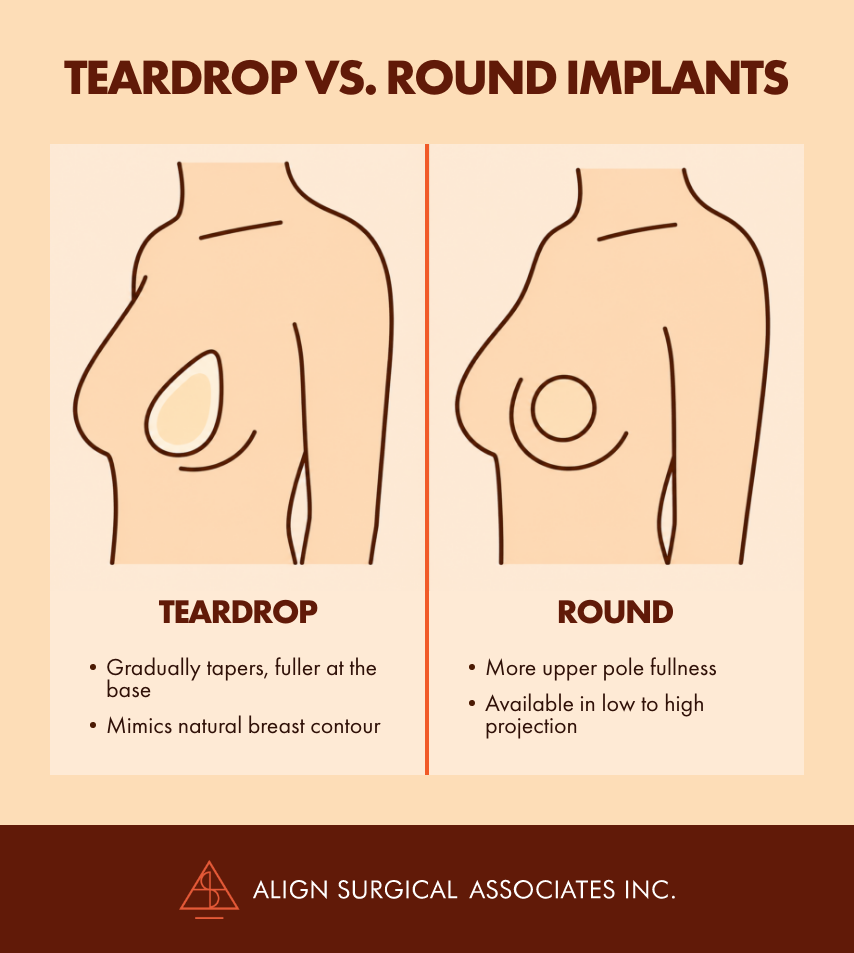
Teardrop vs. Round Implants: What’s the Difference?
Teardrop and round implants are often discussed as competing options, but they serve different objectives: shape and projection.
- Teardrop (anatomical) implants taper toward the top, creating a gradual, sloped contour that mimics the natural breast contour.
- Round implants offer more upper pole fullness and project farther from the chest wall.
In practice, a patient with a narrower chest often benefits from a high-profile round implant, as it delivers greater projection and volume without exceeding the natural chest width. Patients with limited native breast tissue often do better with a teardrop shape, since its gradual taper blends more naturally with thinner tissue coverage and reduces visible rippling. Your surgeon will factor in your chest dimensions and skin elasticity before recommending an implant shape.
How Much Can Fat Transfer Increase Breast Size?
Used alone, fat transfer typically produces a modest size increase of about half a cup to one full cup. The procedure uses liposuction to collect fat from another area, such as the thighs or abdomen, which is then purified and injected into the breasts. Paired with implants, it’s more often used to soften and camouflage visible implant edges and add natural-feeling coverage over the implant, particularly for patients with thin skin or limited native breast tissue. Whether fat transfer is part of your plan usually depends on how much donor fat is available and how much soft-tissue coverage your chest needs.
Take the Next Step
Implant size, shape, and profile all work together, and changing one often changes what’s realistic for the others. Our team will walk you through these trade-offs during your consultation, so your chest surgery result feels true to you and proportionate to your frame.
Ready to talk implant size, shape, and profile with our Align team? Explore additional breast augmentation insights and resources and request a consultation with our chest feminization specialists in Los Angeles or San Francisco by completing the online form or calling us at (415) 530-5335.