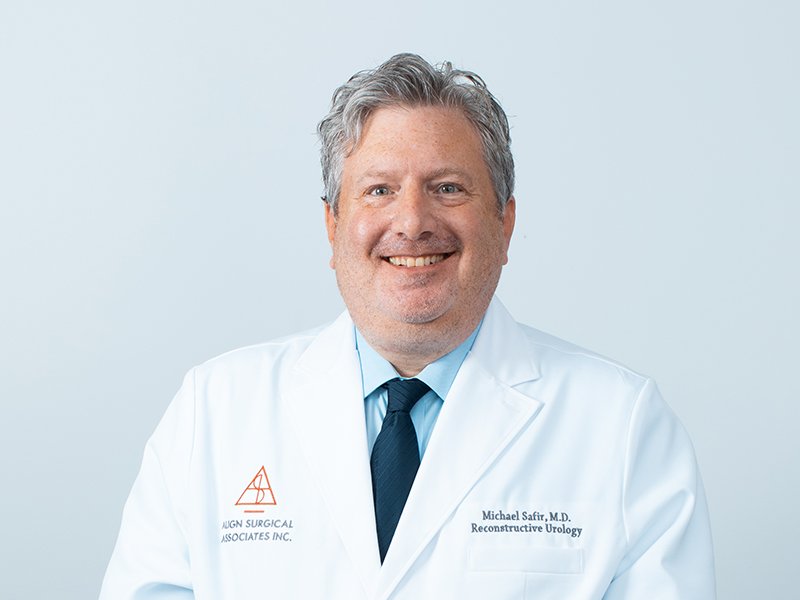
Dr. Michael Safir of Align Surgical Associates recently hosted an Instagram Live session focused on metoidioplasty, a gender-affirming procedure. Throughout the discussion, Dr. Safir clarifies what metoidioplasty entails, how to prepare for candidacy, and the most common concerns patients express.
Caption/subtitle instructions: To turn on subtitles, turn on closed captioning (CC icon), located at the bottom right of the video. To change the language, go to settings > subtitles/cc > auto-translate. Then, select your native language.
Thank you for watching!
Dr. Michael Safir:
My name is Michael Safir. I am a reconstructive urologist, and I am with Align. I work with five other great surgeons. I wanted to talk a little bit today about metoidioplasty. It’s really one of my favorite operations. I tell everyone I like it because there’s a lot of creativity. There are some nuances to the operation that can make things function well and look well. I want to thank you for showing up. If you’re here it means you have some interest in learning a little bit about metoidioplasty. What I’ve done is disabled the comments just so that there are no harmful comments made during the discussion. I promise that we’ll open it up to questions after I have a chance to talk a little bit and hopefully get to a bunch of questions. I’ve always really enjoyed these sessions, and I have learned a lot.
So, what is a metoidioplasty? Well, a metoidioplasty is an operation to create a smaller phallus, a smaller penis. For the most part the patients who’ve seen me in the past have been transmasculine patients. But over the last year, we’ve been seeing more patients who define themselves as non-binary. So, you don’t have to have a certain title to want to have a metoidioplasty. What our patients typically want is they want to have a penis. They want to have a definable organ that they can move in all directions. They want to maximize the length of the phallus. Most patients want to pee standing up, although many don’t, and they really want to have their old genital anatomy usually closed down, although again that’s something that is optional as well. So most of the patients that I’ve seen are patients who have been thinking about phalloplasty, have been thinking about metoidioplasty and once they’ve decided really that penetrative intercourse is not so important a lot of patients begin to gravitate towards metoidioplasty because metoidioplasty uses your body’s own tissue, and we just rearrange things. When you’re developing as a fetus, starting at about 9 weeks, things begin to differentiate in one direction or another, and that’ll define the anatomy that you’re born with. And what we try to do is take what you have and sort of reverse those embryologic changes to provide you with anatomy that makes that makes sense for you. The difference is that at some point we can put in penile implants that are able to result in erection. Phalloplasty you can have a phallos that’s perhaps six in with phallos with phalloplasty with metoidioplasty it’s smaller. Some of the patients who’ve wanted metoidioplasty in the past have asked me about preparation for surgery like how I maximize the size of the phallus and the short answer is it’s tough. Most patients experience growth when they’re on testosterone replacement. People have asked about DHT or dihydrotestosterone cream. It’s not really available in the US. It has no FDA indication. It’s available sporadically in Europe. It’s not clear that it makes a big difference, but I know some patients have used that. Also, pre-operative pumping. We could talk a little bit about that if you have questions at the end, but pumping the phallus, creating a vacuum around the phuserly and postoperatively can help to maximize the size of the phallus.
So who’s a good candidate? Patients with gender dysphoria who are looking for more masculine-looking anatomy, that’s a good starting point. Metoidioplasty is best performed in patients who have had significant growth of the phallus, who don’t have much concealment of the phallus presently from adjacent tissue or extra skin down there. There’s no real BMI cutoff. Although in patients with BMI over 35, it can be hard sometimes to really expose the phallus and make it prominent and visible after surgery. I tell patients when you’ve reached your goal weight, stand in front of a mirror, and if you can’t see the phallus before surgery, you may not be able to see it after surgery. There are some really cool things that we can do in subsequent operations like monsplasty removing some of that pubic fat pad that’s above the phallus and more like second stage kind of metoidioplasty procedures to try to place the penis higher up, higher than the scrotum in order for it to have a more normal and visible appearance. Whereas in patients with higher BMIs, it’s hard sometimes to see the phallus, there are things that we can do and I’d encourage you to get a consultation so that you know you can individually be seen because there’s a lot of factors that we consider. What are your health issues? What are your goals? Do you have reproductive goals? Are you thinking of having a phalloplasty in the future but want a metoidioplasty now? We’ve done about 12 patients who’ve had prior metoidioplasties who want phalloplasty so really it doesn’t burn your bridges to get a metoidioplasty if you eventually might want phalloplasty or you’re not sure. These are good things to talk about in advance. When I counsel patients about the proper operation for them, we explore what’s going on. What are you looking for? What do you want things to look like? Do you want to retain your current anatomy? Do you want us to eradicate your current anatomy? What changes do you want? How do you want things to end up looking? And if you verbalize it used to be that we would there was one way of doing metoidioplasty and that was to do everything or to do just one thing.
There’s one procedure called a simple metoidioplasty which essentially means that we release all of the ligaments that are keeping the phallus from moving in all directions. We wrap the phallus completely in skin and make it a definable organ. For many patients, that’s exactly what they want. They don’t care about peeing out of the tip of the phallus. They want to, for instance, retain the vagina. So simple metoidioplasty can be a way to have a phallus without some of the complications that can be associated with urethral lengthening. So that’s a little bit about the counseling and how does the procedure, how do we do it, and what changes do we make? It’s a procedure that we start early in the morning. We’re usually done around 12:30 in the afternoon. It doesn’t require microsurgery. I do the procedure all myself. The first part of the procedure is to put in what’s called a supra pubic tube, which is going to be a small tube above the pubic bone that’s going to drain all of your urine for two weeks. So, you won’t be peeing for two weeks after surgery. Two weeks later we’ll give you a chance to pee. This really applies to patients who want urethral lengthening and who have a goal of urinating out of the tip of the phallus. And I’ll describe that type of patient in the subsequent steps of the operation. After we put the super pubic tube in, what we typically do next is to do the vaginectomy. That means we’re going to close down the canal and remove the lining of it so that it doesn’t exist anymore. The next step is to lengthen the urethra, to take the urethra from its current position, and bring it all the way to the tip of the phallus. At the same time we’re doing that, we’re releasing all of the ligaments that are supporting the phallus in position and restricting its motion in various directions. We intraoperatively will test that to make sure that we’re really trying to achieve what your surgical goals are. After that, we use the majora tissue to create a scrotum underneath the penis. You’ll have the skin, the fat in the scrotum. It’ll be a definable pouch, but it won’t have the testis implants in yet. When we do testis implants that’s usually around 6 to 9 months after surgery. We have to let healing occur. We have to let the space in the scrotum develop itself. We have to let the tissues soften and make them suitable for implant surgery and that’s something we can assess postoperatively once you’ve had a few months to recover from the surgery. At this point we’ve closed down the canal, we’ve closed the perineum, that area between the back of the scrotum and the anus. We built that scrotum. We’ve lengthened the urethra if that’s what you want us to do. We have released the ligaments to the phallus, we have in sheathed it in skin and the super pubic tube is in place and so those are the steps that we go through in order to do the surgery. After surgery we usually watch you in the hospital for at least a night. A lot of questions, it’s hard for me to get my hysterectomy done. Why do I have to have a hysterectomy done before surgery? The reason is if we’re closing down the vaginal canal, then all the cells and the fluid that are produced by the cervix and the uterus, they have nowhere to go. If you want to have the vagina closed down, then we have to do hysterectomy we’ve developed a procedure to allow hysterectomy to be done at the same time as metoidioplasty. Some patients that don’t have the opportunity to or access to gynecologists who do the surgery in the trans community we’ll have them come out we’ll do the hysterectomy and the metoidioplasty at the same time. Alternatively, patients can elect to have their hysterectomy done near their home. Allow usually a few months to heal and then we do the metoidioplasty.
What are the common variations? It used to be that we either did that simple metoidioplasty, or we did a full metoidioplasty. But now patients are beginning to understand that there are other procedures that may more directly and completely address their individual form of gender dysphoria. The three items that they want to say yes or no to is scrotoplasty, building the scrotum, urethral lengthening, bringing the urethra to the tip of the phallus or leaving it where it is so that you sit to pee, and vaginectomy, closing down the vagina. We’ve done the procedure and all of those combinations and permutations of the surgery. Once you discover or come to us with an idea of what you’re looking for, we can make sure it’s something that’s doable for your body’s anatomy and alert you to some combinations of the surgery that may be associated with more risk with regard to urination.
Function and sensitivity. Really good question. It’s rare to lose any sensation in the phallus after phalloplasty. We know where the nerves are. We know how to stay away from the nerves. The nerves run on top of the phallus in an area that we intentionally don’t operate on. So it’s really unusual for patients to lose sensation. It’s unusual for them to lose any erotic sensation. Most of our patients are able to orgasm after surgery. When we talk about sensation, we’re talking about both sensitivity to fine touch, meaning if you’re touching it or it’s rubbing up against the underwear, you’ll feel it, but also, erotic or erogenous sensation. So long-term, our patients have not had difficulty, with impaired sensation. We do list it as a possible surgical risk. We haven’t encountered it. I like to imagine it’s due to our care and preserving those nerves. Thankfully, it’s something that hasn’t been an issue for our patients. When patients show up, they usually show up with an idea of whether they want metoidioplasty or phalloplasty but sometimes patients come to the office and really aren’t sure which procedure is going to suit their needs. They oftentimes come in with a partner, and we have an opportunity to talk about the benefits of phalloplasty, the benefits of metoidioplasty, and the risks that are associated with it. A lot of patients choose metoidioplasty because they’re concerned about phalloplasty which involves bringing skin and fat from some other area of the body and creating a phallus and in many cases hooking it up to a new blood supply which is generally a really safe procedure but does add some risk to the operation. Phalloplasty patients typically stay in the hospital for around 5 days when I do them. The first three days are in the ICU and that is in comparison to metoidioplasty in which patients usually are discharged after a night or two. What are those first couple of nights like after metoidioplasty? If we’re watching you in the hospital or overnight at the facility, you’ll have as much pain medication as you need to keep you comfortable. We use a lot of long-acting local anesthesia during the procedure. So, there isn’t a terrible amount of discomfort after surgery. But one of the reasons that we watch you is just to make sure that we arrive at the perfect combination of pain medication that’s going to help you and not sedate you too much. We look for things such as bleeding. We assure that the super pubic tube continues to drain without difficulty, and we watch out for other complications and being in the hospital for a night or two, or in the facility where we do the procedure. It really gives us the opportunity to teach you about your new anatomy, to teach you about how to manage the super pubic tube for two weeks until we get you urinating on your own, to perform other teaching with regard to dressing changes and to go over the schedule of medications you’re going to use after surgery. I should say – and it’s important to say – that if you if you elect to have the surgery done without urethral lengthening, you do avoid a lot of the complications that can be associated with surgery. Urethral complications are not terribly common. They occur in about 17% of patients. When it is a complication, usually it’s the form of fistula where urine is able to drain from some other area other than the tip of the phallus. If you make a decision that standing to pee isn’t that important, you really bring surgical complications related to the urethra almost to 0%. You also negate the need for having a super pubic tube in place. And so typically patients will be urinating on their own between five and seven days after surgery without the need for any catheters. So there are some advantages to not doing urethral lengthening. But in patients whose dysphoria drives them to the need to have to stand to pee we build a urethra for you. Like I said, about 83% of patients are able to avoid without fistula afterwards. We think those numbers are pretty good. We’re looking forward to improving those numbers in the future in terms of what’s on the horizon. We have some exciting things that we’re going to start to do just to decrease the injury to adjacent tissue during the procedure to minimize scarring resulting from the surgery. To make really precision incisions without any char effect or any edges of the incision that they have as good blood supply as possible after surgery. There are some really neat things on the horizon for surgery. I would encourage you to visit our website alignsurgical.com. Consultations take longer than 30 minutes, and I’m sure that you have a lot of questions. Visit our gallery. There are a lot of really good pictures of metoidioplasty on there that can show you some examples. I’m going to open things up to some questions. I see we have a bunch of questions.
When do you recommend patients who are interested in surgery see you for consultation? What if they are still undecided or haven’t yet determined which procedure is the right approach for them? The sooner the better. If you need for instance to have a hysterectomy done, you need to get an authorization for that locally, get your hysterectomy done, recover for three months, and then have your metoidioplasty. Sometimes we can do those at the same time, but there’s a lot of planning that’s involved. There is insurance authorization, compiling letters of support. Sometimes there’s a wait list for the procedure. I encourage patients that’s a really good time to come in when you’re undecided because sometimes things can really tip the balance either medical issues or anatomical differences or things that are uncovered during the consultation. So, the sooner you come in, the sooner we can determine what the ideal procedure is for you.
Someone who had surgery a couple of years ago wondering about having a revision with us, had a tough experience with insurance and hoping not to go through the same thing. Revision surgery is not uncommon. Revision surgery typically takes the form of urethral reconstruction if for some reason there’s a fistula or some urinary problem. Revision can also take the form of dropping down some of the scrotal tissue that is flanking or compel competing for real estate with the phallus. Sometimes that can be a cause of penile concealment and we have to sort of exhume or bring forward the phallus by dropping down the scrotal tissue. We do a lot of revision surgery. The codes for revision surgery are very different than the codes for metoidioplasty. They’re typically a lot less extensive. They’re submitted to your insurance carrier for authorization. It’s a pain in the neck. We all suffer a little bit through it, but because the codes aren’t as extensive, it may be easier for you to get authorization for the procedure, the recovery typically is not as involved. It doesn’t involve many weeks in town depending on what you need. Revision can also take the form of testis implants and sometimes if you need even minor or major revisions we can insert testis implants at the same time. So, again coming in person is really helpful especially for the revision patients we can do it over Zoom but at some point it’s great to see you so that we can plan exactly what we need to do make sure that we’re addressing what you need us to address.
A question about preparation for metoidioplasty about DHT cream um it’s not available in the US there’s a 2 ½% solution or 7 two and a half % cream available in Europe maybe in France does it work? We don’t really know, DHT is the form of testosterone that works on the genitals. Testosterone itself doesn’t directly work on the genitals. It can help as a cream restore it in your body, but it can’t cause local growth.
Does preop or post-op pumping work? Yes. Are there any weight restrictions? We talked a little bit about higher BMIs causing concealment. Implant surgery is open to just about everyone. With testis implants, we have various sizes that are available and we can, combine it with other revision surgery if necessary.
Any tips for performing vaginal preserving metoidioplasty also with urethral lengthening? Yeah, that combination is a complicated operation. It’s tough to describe in a few words why, but the combination of vaginal preservation with urethral lengthening can increase the fistular rate. We’ve done a number of them and we have some surgical maneuvers to try to reinforce the area with tissue that has a reliable blood supply. So we do that procedure. Some surgeons don’t do that procedure. If you’re interested, happy to see you.
Training experience? I trained at UCLA and UCSF in reconstructive surgery. I’ve done about a hundred metoidioplasties. Align is a great place to come for all of your surgery. We meet as a group to discuss how to make these procedures better and better. We have a number of physicians in our practice who are doing them. That gives us a lot of opportunity to cross fertilize with ideas particularly for complicated revision cases or tailored procedures that patients sometimes challenge us with.
What do we hope patients take away from this conversation? That there are a lot of options in how to do your surgery. That the available options perhaps are a lot broader than they used to be in years since the surgery itself has improved. That you don’t have to define yourself a certain way to qualify for the surgery. You don’t have to distinctly qualify yourself as transmasculine to have the surgery. Metoidioplasty is about precision with incisions to leave the tissue as undisturbed as possible. Improvements in handling the urethra and reinforcing it with tissue that has a reliable blood supply. That’s I think where most of the changes are going to be. Some of the things I’m working on are doing more extensive dissections to free up the phallus to gain additional length. These operations are really complex. I only do bottom surgery. So, that allows me to focus on a small area of the body and gain experience doing just a few types of operation. I think that has enabled me to make changes and pursue more aggressive surgery for the patient who really it’s important for them to have as much length on the phallus as possible. So those are exciting things that are on the horizon. Like I said, it’s an operation that I love. I encourage you just to visit our website, look at some of the galleries, make an appointment. Initial appointments are by Zoom or by phone or locally if you’re local to LA, or San Francisco. I practice in both locations. Come on in even if you’re not sure and come on in even if you had surgery and been told maybe that it’s the end of the road for you, that nothing can be done. Sometimes there are alternatives to pop into that pop into our mind because we have the ability to focus on a small number of procedures.
Hopefully I got to answer some of the questions that were of interest to you. Hopefully we’ll have a chance to talk again. I encourage you to visit our social media and our website, and it’s been really a pleasure.
Thanks for listening.