Facial features can play a key role in how we see ourselves and how we are perceived by others. For the transgender community, gender-affirming surgeries help align outer appearance with a person’s gender identity. Orthognathic surgery is one example of a transformative surgery that can make a significant impact on gender expression and self-confidence.
What is Orthognathic Surgery?
Orthognathic surgery, also known as corrective jaw surgery, reshapes the jaw to correct misaligned teeth and addresses jaw issues that cannot be resolved with orthodontic treatments like braces. It is often used to correct a patient’s large overbite or, more commonly, a large underbite.
Two operations are performed to fix the protruding chin caused by an underbite. The first involves cutting along the bone between the gums and the inside of the upper lip. Once detached, the upper teeth can then be repositioned. The second operation entails removing sections from the left and right sides of the lower jawbone, then reattaching the remaining parts, resulting in a smaller mouth. (See illustrations below)
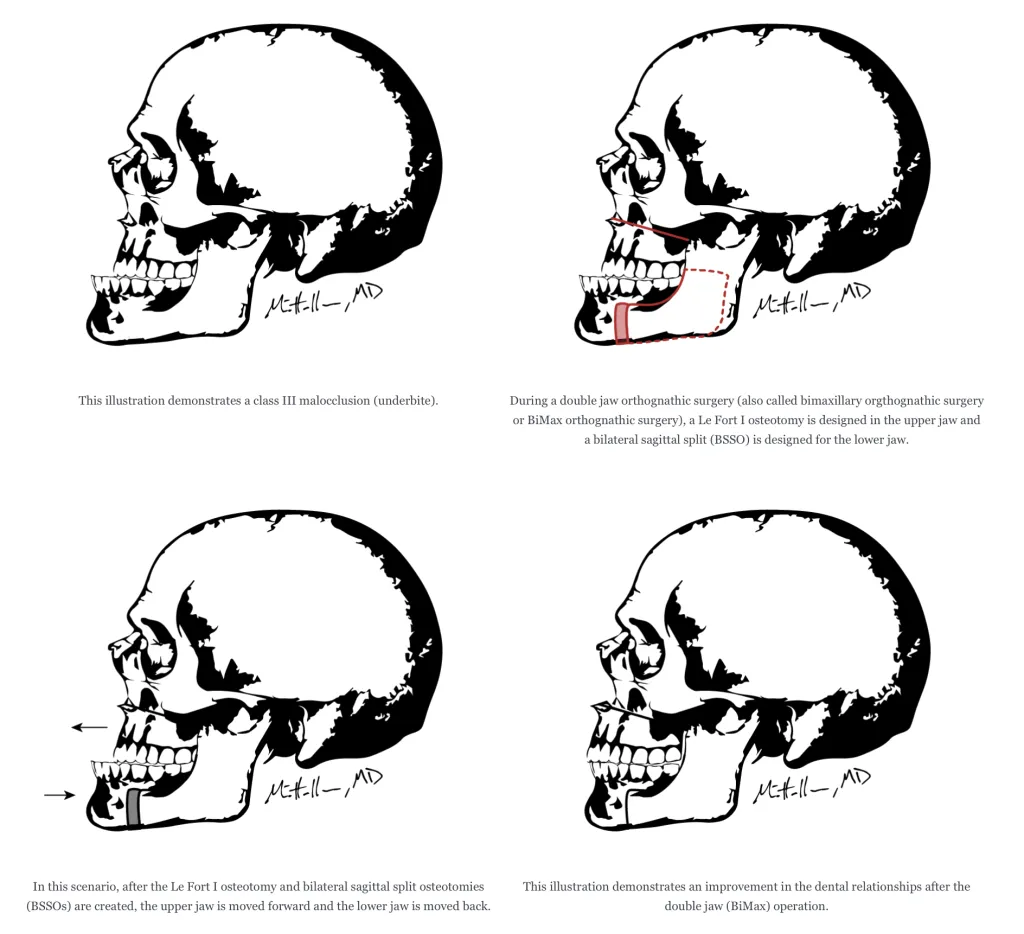
Orthognathic surgery is also used for facial feminization, focusing on decreasing the patient’s jaw size and reducing the masculine appearance of a large lower jaw, resulting in a more feminine appearance.
Considerations Before Surgery
Orthognathic surgery is performed in conjunction with orthodontic treatment to achieve optimal jaw function. Orthodontics are not always covered by insurance, so we recommend patients check their insurance plan before continuing.
What should somebody expect after surgery?
At the beginning of the recovery process, the patient usually stays for some time in the hospital. Recovery will take several weeks, and it is recommended that a patient take a few weeks off work. They will also need to follow a special diet consisting of liquids and soft foods for about four to six weeks, but patients should always follow their surgeon’s post-operative care plan. With larger procedures like orthognathic surgery, significant swelling is expected, however, the majority of swelling subsides within about a month.
If you are interested in facial surgery, Dr. Paul Mittermiller specializes in craniofacial plastic surgery, including orthognathic surgery. Click here to schedule a consultation.