
If you’re considering phalloplasty, one of the first decisions is where on your body the surgeon will take tissue to build the new phallus. Radial forearm free flap (RFF) phalloplasty takes that tissue from the forearm, while anterolateral thigh (ALT) phalloplasty takes it from the thigh.
Your choice of phalloplasty donor site affects everything from scar placement to tissue thickness, urethral reconstruction, and sensation, which is why so many patients want to compare RFF vs. ALT phalloplasty long before a consultation. Here’s what tends to change from one approach to the other, and what questions you should consider as you decide.
How Do the Scars Compare for RFF and ALT Phalloplasty?
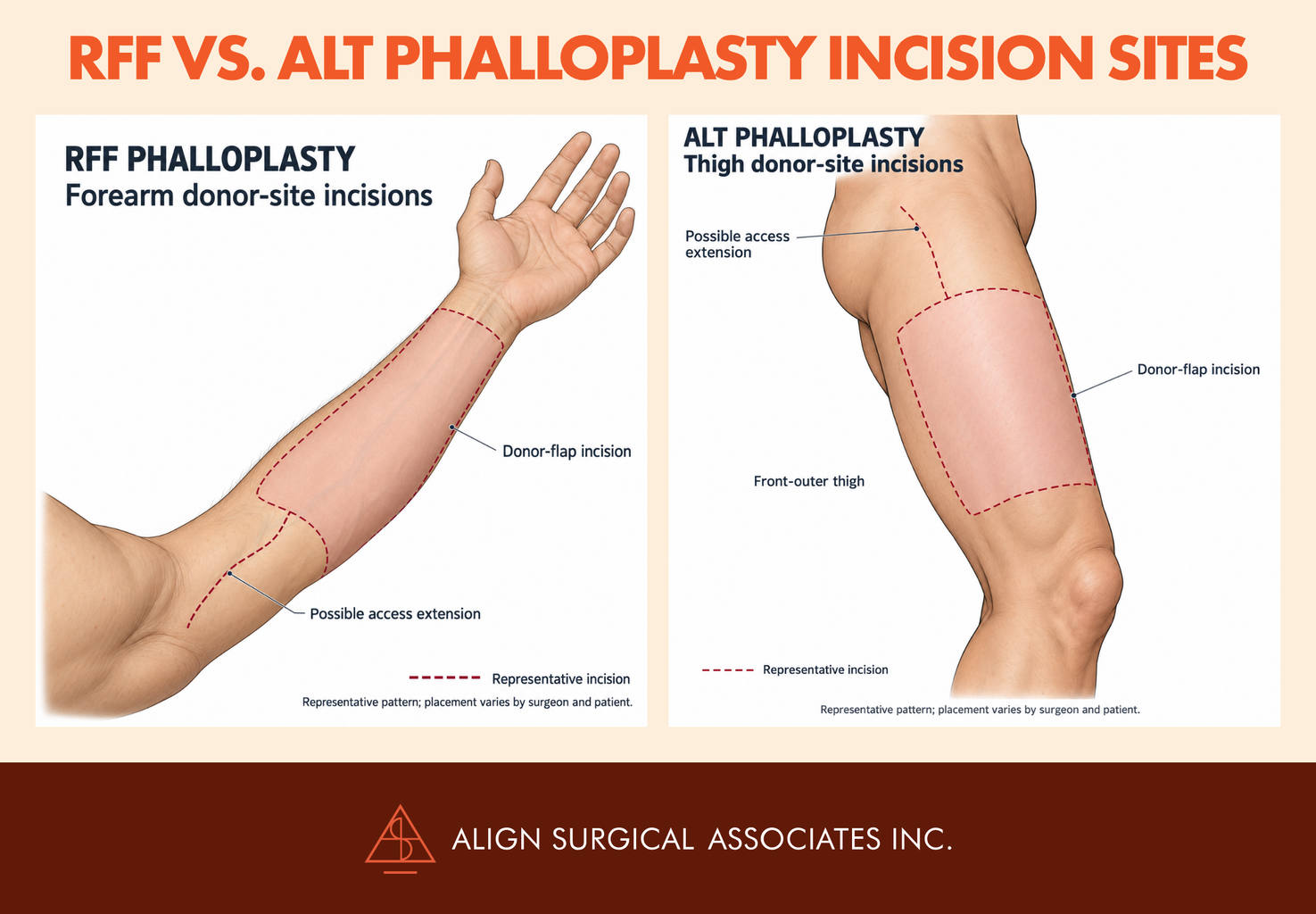
RFF leaves a visible scar along the forearm, while ALT leaves one on the outer thigh, where clothing can cover it more easily. The arm scar after RFF phalloplasty often requires a skin graft, which is usually taken from the thigh.
In some cases, a skin graft is also needed after ALT phalloplasty. This graft is typically taken from the opposite thigh. For both types of phalloplasty, patients should be aware that a skin graft will leave a separate scar.
Certain patients may be eligible for a technique called single scar phalloplasty, which was created by Align Surgical Associates’ own Dr. Dev Gurjala.
How Do RFF and ALT Phalloplasty Results Compare?
Both techniques can produce strong aesthetic and functional results, with many of the differences tracing back to tissue thickness. Forearm skin is thin and flexible, so it rolls easily into the inner tube that forms the urethra.
Thigh tissue, meanwhile, is thicker, so ALT phalloplasty results may involve thinning the flap to refine its shape and may involve more steps to form the urethra. Depending on your plan, either phalloplasty approach can support urethral lengthening for standing urination.
Does RFF or ALT Phalloplasty Offer Better Sensation?
In our experience, RFF tends to offer better sensation, though both techniques can achieve good sensation over time. We perform these as microvascular surgery, which means we reconnect the new tissue’s blood vessels and nerves to those in the pelvis. Blood flow keeps the tissue healthy, and sensation returns gradually as the nerves heal.
How Do You Decide Between RFF and ALT Phalloplasty?
Start with what matters most to you, then bring specifics to your surgeon. Ask yourself how visible a scar on your forearm or thigh would feel, and whether your work and hobbies lean more on your hands and arms or on your legs.
We also encourage you to ask what recovery at each donor site involves and how many stages your plan may include during your conversation.
Comparing Phalloplasty Donor Site Options
| CONSIDERATION | RFF (Forearm) | ALT (Thigh) |
| Donor-site recovery | Forearm and hand care during healing; grip strength and sensation changes are reviewed ahead of time | Early limits on thigh activity; your surgeon guides walking and movement |
| Contour shaping | Thin tissue usually needs little thinning | Thicker tissue may be downsized for a refined shape |
| Planning factors | Hand dominance and daily arm use | Thigh tissue thickness and whether a graft is needed |
| Question to ask | “How will forearm recovery affect my daily tasks?” | “How would the thigh tissue be shaped for my goals?” |
Take the Next Step
Every donor site involves trade-offs, and the right fit depends on your anatomy and goals. Our board-certified surgeons are here to answer your questions and guide you to the best approach for your needs. To get started, request a consultation or call (415) 530-5335.