Phalloplasty scars vary depending on the surgical technique used and the donor site selected. These scars include both the donor site (where tissue is taken) and the surgical site itself, though donor site scars are typically the most visible and most commonly discussed. In general, scars may appear as linear or graft-pattern marks on areas such as the forearm, thigh, or lower abdomen.
At Align Surgical Associates, we guide you through each phase of the process with education, transparency, and personalized care. This includes helping you understand what to expect from scar outcomes—a concern many phalloplasty patients share—so you can make informed, confident decisions aligned with your surgical plan, individual embodiment goals, and long-term results.
Where Are Phalloplasty Scars Located?
The location of phalloplasty scars depends on the customized technique and your overall surgical plan. Donor site scars are typically the most noticeable, but there are also scars where the phallus is created and attached:
Common donor site locations include:
- Radial Forearm Free Flap (RFFF): A visible scar along the forearm, often requiring a skin graft. This is one of the most recognizable phalloplasty donor site scars.
- Anterolateral Thigh (ALT): A scar on the outer thigh, which can often be more easily concealed under clothing.
- Latissimus Dorsi (Back Muscle): A scar along the upper or mid-back. This approach can provide a larger amount of tissue and may be considered when other donor sites are not suitable due to prior scarring, body composition, or personal preference.
- Abdominal-Based Flap: Lower abdominal scarring, sometimes similar in placement to a tummy tuck incision.
- Single Scar Phalloplasty (SSP): A modern approach developed by Dr. Dev Gurjala that uses a single linear scar along the thigh, designed to reduce the overall visible scarring footprint compared to other approaches.
In addition to donor site scars, there is also an incision where the phallus is connected to the genital area. Depending on your surgical plan, there may be additional incisions to shape the glans, support standing urination through urethral lengthening, or place a penile implant for penetrative function.
Our phalloplasty surgeons, including Dr. Gurjala and Dr. Michael Safir, carefully evaluate your anatomy, goals, and preferences to help determine the most appropriate option. At our practice, we prioritize the function and aesthetics of the phallus itself, as well as how donor site scarring may affect your overall experience and confidence.
What Is the Phalloplasty Scar Healing Timeline?
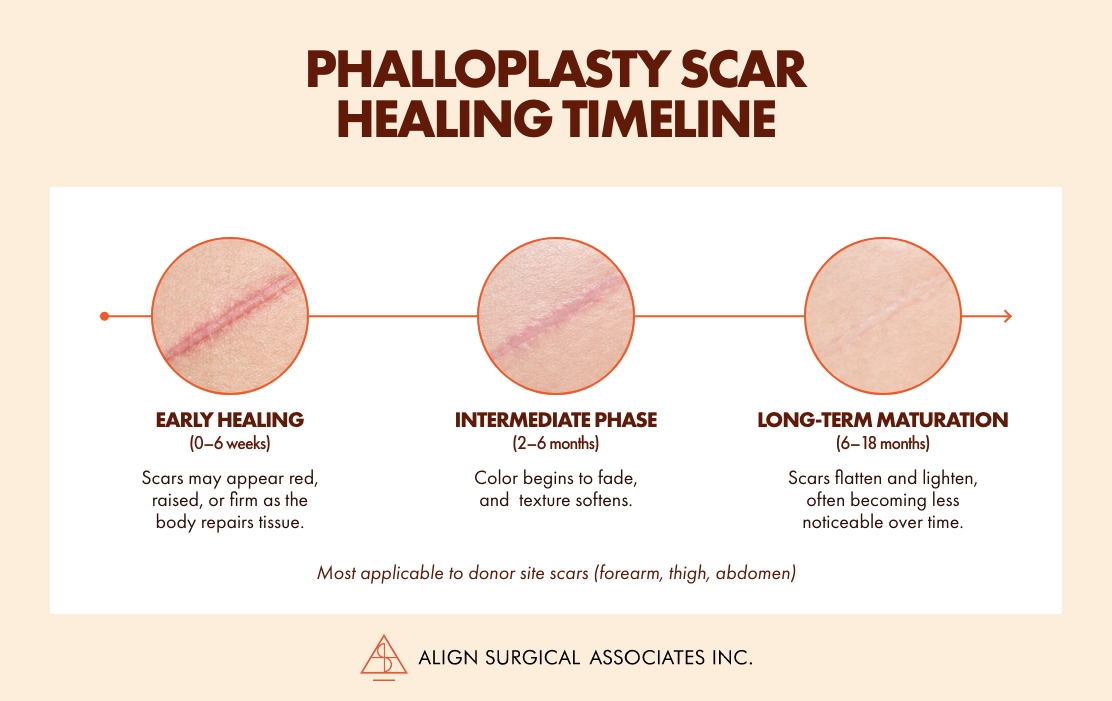
Phalloplasty scar healing occurs in stages:
- Early healing (0 to 6 weeks): Scars may appear red, raised, or firm as the body repairs tissue.
- Intermediate phase (2 to 6 months): Color begins to fade, and texture softens.
- Long-term maturation (6 to 18 months): Scars flatten and lighten, often becoming less noticeable over time.
Because phalloplasty is often staged, healing timelines may overlap or extend depending on the procedures performed. We provide detailed aftercare guidance to support optimal healing and comfort at every stage.
Can Phalloplasty Scars Be Minimized or Improved?
Yes, there are several options to support scar healing and improve the appearance of scars over time. Most strategies are focused on donor site scars, while care for the phallus itself is more individualized and guided closely by your surgical team. At Align Surgical Associates, we incorporate advanced techniques and postoperative care strategies, including:
- Thoughtful incision placement and microsurgical techniques
- Scar care protocols (silicone, massage, sun protection)
As part of our broader commitment to comprehensive, affirming care, we can connect you with trusted specialists who offer scar tattooing and medical pigmentation to help blend color differences and enhance your overall aesthetic outcome.
How Do I Choose the Right Approach for Me?
Choosing the right phalloplasty technique involves balancing several factors:
- Desired appearance and function
- Comfort with potential donor site scars
- Lifestyle considerations and recovery priorities
Some patients also benefit from exploring metoidioplasty, which uses hormonally enlarged genital tissue and avoids large donor site scars. Dr. Safir offers metoidioplasty as part of our full-spectrum gender-affirming surgical care.
Our experts take a personalized, research-informed approach to every surgical plan. Whether you are considering established techniques like RFFF, ALT, or innovative options like single-scar phalloplasty, we work with you to align each decision with your individual embodiment goals.
What’s Next?
If you are considering phalloplasty and want to better understand the procedure and what scars may look like for you, we encourage you to request a consultation with Align Surgical Associates by completing the online form or calling us at (415) 530-5335.
Our team is here to provide clear guidance, answer your questions, and support you in making informed decisions that reflect your goals, preferences, and long-term vision for your body.