
Metoidioplasty and phalloplasty are both effective options for masculinizing bottom surgery, but they serve different embodiment goals, involve different levels of surgical complexity, and produce different results. Instead of a one-size-fits-all decision, the right choice depends on individual priorities and factors, such as sensation, size, staging, and scarring.
At Align Surgical Associates, we’re committed to guiding you through your options with clarity, transparency, and compassion, drawing on the expertise of our Los Angeles and San Francisco surgeons, Dr. Michael Safir and Dr. Dev Gurjala. Below, we provide insights on how to best understand and weigh your options before you take your next steps toward achieving your embodiment goals.
What Is the Difference Between Metoidioplasty and Phalloplasty?
While both are gender-affirming procedures, metoidioplasty and phalloplasty differ primarily in tissue source and resulting size. Metoidioplasty releases hormonally enlarged genital tissue, creating a small phallus. The tissue stays connected to its original nerves and blood supply, typically preserving erotic sensation and natural erectile function.
In contrast, phalloplasty constructs a neophallus using tissue transferred from another area of the body, such as the forearm or thigh. This allows for a larger phallus with options like standing urination and, later, penile implant placement.
Should I Choose Metoidioplasty if I Want To Preserve Natural Sensation?
At Align Surgical Associates, metoidioplasty is often the preferred option for patients whose top priorities are:
- Preserving sensation and function
- A less invasive surgical approach
A simple metoidioplasty focuses only on releasing the tissue, while a full metoidioplasty can add urethral lengthening for standing urination and scrotoplasty. In full transparency: metoidioplasty creates a noticeably smaller phallus than phalloplasty, and for some patients, that trade-off ultimately leads them to choose phalloplasty instead.
When Is Phalloplasty the Preferred Choice?
Phalloplasty tends to be the better fit for patients whose embodiment goals include:
- A larger, more anatomically typical phallus
- Standing urination
- Eventual penetrative function through a penile implant
Dr. Safir has performed more than 230 microvascular phalloplasty procedures and often combines multiple elements of the reconstruction into fewer stages to reduce the number of separate operations and recovery periods. Because phalloplasty draws tissue from a donor site (commonly the forearm, thigh, abdomen, or back), the decision also involves weighing scar visibility, tissue characteristics, and staging against your priorities for sensation and function. Your safety and comfort are always among our top considerations, as well.
Does Single Scar Phalloplasty Reduce Donor-Site Scarring?
Yes. In fact, Dr. Gurjala’s Single Scar Phalloplasty (SSP) technique was developed specifically to address donor-site scarring, one of the most common concerns patients raise about traditional phalloplasty.
As the inventor of SSP and the only provider currently offering it, Dr. Gurjala adapted tissue expansion and pre-lamination principles to reduce donor-site scarring to a single linear scar on the thigh or abdomen, eliminating the need for a skin graft. SSP isn’t the right fit for every anatomy or surgical plan, but for patients who are drawn to phalloplasty’s results—yet hesitant about visible scarring—it’s a meaningful option to discuss during consultation.
Can I Combine or Stage These Procedures?
Yes, phalloplasty is typically staged by design, dividing reconstruction into separate procedures so tissue can heal, and circulation can stabilize before the next step.
Metoidioplasty, particularly a full metoidioplasty with urethral lengthening and scrotoplasty, may also involve more than one stage depending on your surgical plan. What metoidioplasty and phalloplasty don’t offer is a path between each other. They’re distinct procedures using different tissue sources, so the decision isn’t about combining them; it’s about determining which one, or which staged version of one, matches your goals.
How Do I Decide Which Procedure Is Right for Me?
The clearest way to decide is through a consultation in which your anatomy, priorities, and desired outcomes are evaluated directly. Dr. Safir and Dr. Gurjala both approach this decision individually, rather than steering patients toward a single standard path for metoidioplasty versus phalloplasty. They weigh factors such as sensation, size expectations, scarring tolerance, staging, and long-term function to help you arrive at the approach that best aligns with your long-term needs and goals.
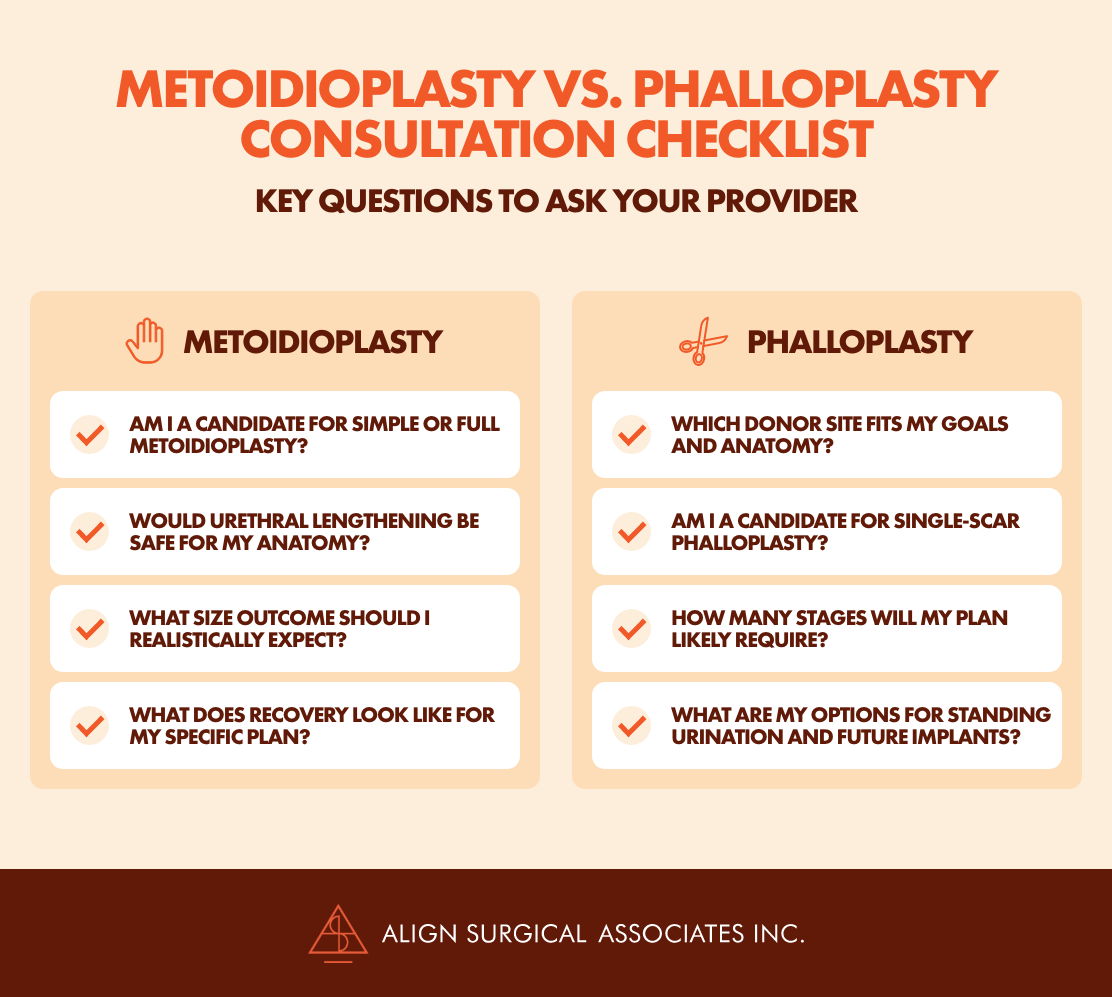
Explore Your Bottom Surgery Options with Align Surgical Associates
If you’re considering a gender-affirming body surgery, we encourage you to request a consultation with Align Surgical Associates to discuss whether metoidioplasty, phalloplasty, and specific techniques like SSP best match your embodiment goals. Our knowledgeable, caring team looks forward to guiding you through your treatment at every stage.